- Stopień zaawansowania raka płuca określa się za pomocą systemu TNM: T — wielkość guza, N — węzły chłonne, M — przerzuty
- Wyróżnia się stopnie od 0 do IVB — im wyższy stopień, tym bardziej zaawansowany nowotwór
- Rak drobnokomórkowy płuca (SCLC) dzieli się na postać ograniczoną i rozległą
- Im wcześniej choroba zostanie wykryta, tym lepsze rokowanie i więcej opcji leczenia
Stopień zaawansowania raka płuca klasyfikuje się za pomocą systemu TNM: T – wielkość guza, N – węzły chłonne, M – przerzuty. Wyróżnia się stopnie od 0 do IVB; im wyższy stopień, tym bardziej zaawansowany nowotwór. Rak drobnokomórkowy płuca (SCLC) dzieli się na postać ograniczoną i rozległą. Im wcześniej choroba zostanie wykryta, tym lepsze rokowanie i więcej opcji leczenia.
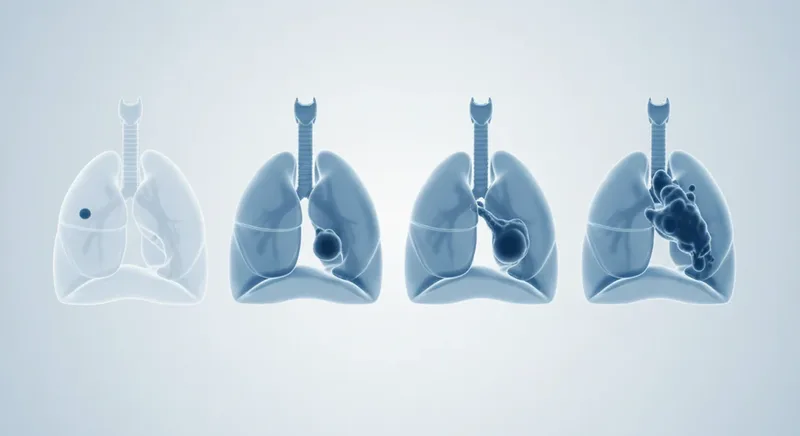
Klasyfikacja TNM raka płuca (8. edycja, 2017 r.)
System TNM jest międzynarodowym standardem stosowanym do opisu raka płuca. Każda litera odzwierciedla inny aspekt: T – guz pierwotny, N – stan węzłów chłonnych, M – przerzuty odległe.1
T — guz pierwotny
- TX: nie można ocenić guza pierwotnego lub jego obecność potwierdzają jedynie komórki nowotworowe w plwocinie lub popłuczynach oskrzelowych.
- T0: brak guza pierwotnego. Tis: rak in situ.
- T1: guz ≤3 cm, otoczony przez płuco lub opłucną trzewną (T1a ≤1 cm; T1b >1–2 cm; T1c >2–3 cm).
- T2: guz >3–5 cm lub zajmujący oskrzele główne, naciekający opłucną trzewną lub związany z niedodmą (T2a >3–4 cm; T2b >4–5 cm).
- T3: guz >5–7 cm lub naciekający ścianę klatki piersiowej, nerw przeponowy, opłucną śródpiersiową lub osierdzie ścienne; lub oddzielne guzki w tym samym płacie.
- T4: guz >7 cm lub naciekający przeponę, śródpiersie, serce, wielkie naczynia, tchawicę, przełyk lub kręgi; lub guzki w innym płacie.
N — przerzuty w regionalnych węzłach chłonnych
- NX: nie można ocenić. N0: brak przerzutów.
- N1: przerzuty w węzłach chłonnych okołooskrzelowych, wnękowych lub wewnątrzpłucnych po tej samej stronie.
- N2: przerzuty w węzłach chłonnych śródpiersiowych lub podrozwidleniowych po tej samej stronie.
- N3: przerzuty w węzłach chłonnych śródpiersiowych/wnękowych po przeciwnej stronie lub w jakichkolwiek węzłach nadobojczykowych.
M — przerzuty odległe
M0: brak przerzutów odległych. M1: obecne przerzuty odległe (M1a w obrębie klatki piersiowej; M1b pojedynczy przerzut odległy; M1c liczne przerzuty odległe).
Rak drobnokomórkowy płuca (SCLC) — stopnie zaawansowania
SCLC dzieli się w prostszy sposób na dwie kategorie: postać ograniczoną (ograniczona do jednej strony klatki piersiowej, możliwa do leczenia w ramach jednego pola radioterapii) i postać rozległą (rozprzestrzeniona poza jedną stronę klatki piersiowej lub do odległych narządów).
Chemioterapia i radioterapia hamują odporność. Badane jest zastosowanie stężonych polisacharydów z grzybów w celu aktywacji komórek NK i makrofagów.
Lentinan AXT firmy Zenius Labs™ →Często zadawane pytania
Za pomocą systemu TNM (8. edycja, 2017 r.): T (wielkość i naciekanie guza), N (regionalne węzły chłonne), M (przerzuty odległe). Na ich podstawie określa się stopnie od 0 do IVB. Rak drobnokomórkowy płuca dzieli się w prostszy sposób na postać ograniczoną lub rozległą.
Postać ograniczona SCLC jest ograniczona do jednej strony klatki piersiowej i można ją leczyć w jednym polu radioterapii. Postać rozległa SCLC rozprzestrzeniła się poza jedną stronę klatki piersiowej lub do odległych narządów.
Im wcześniej choroba zostanie wykryta, tym lepsze rokowanie i więcej opcji leczenia. Stopień zaawansowania decyduje o tym, czy właściwe jest leczenie chirurgiczne, skojarzona chemioradioterapia czy leczenie systemowe.
Tak. Chemioterapia i radioterapia hamują działanie układu odpornościowego. Skoncentrowane preparaty polisacharydowe z grzybów, takie jak Lentinan AXT firmy Zenius Labs™, są badane pod kątem aktywacji komórek NK i makrofagów.
- Yin X et al. A meta-analysis of lentinan injection combined with chemotherapy in the treatment of nonsmall cell lung cancer. Indian journal of cancer. 2015. PubMed
- Zhao C et al. Lentinan combined with cisplatin for the treatment of non-small cell lung cancer. Medicine. 2021. PubMed
- Li M et al. Lentinan triggers oxidative stress-mediated anti-inflammatory responses in lung cancer cells. Molecular and cellular biochemistry. 2022. PubMed
- Gui Y et al. Oridonin improves the therapeutic effect of lentinan on lung cancer. Experimental and therapeutic medicine. 2021. PubMed
- Wang Y et al. Investigation on the efficiency of lentinan for injection combining cisplatin on treating malignant pleural effusion based on systematic review and meta-analysis. Medicine. 2024. PubMed
- Song Z et al. Translational Nanotherapeutics Reprograms Immune Microenvironment in Malignant Pleural Effusion of Lung Adenocarcinoma. Advanced healthcare materials. 2021. PubMed
- Congcong Q et al. Evaluation of Efficacy and Safety for Lentinan in the Control of the Malignant Pleural Effusions via Intrapleural Injection. The American journal of the medical sciences. 2019. PubMed
- Ansell SM et al. PD-1 blockade with nivolumab in relapsed or refractory Hodgkin’s lymphoma. The New England journal of medicine. 2015. PubMed
- Goodman A et al. PD-1-PD-L1 immune-checkpoint blockade in B-cell lymphomas. Nature reviews. Clinical oncology. 2017. PubMed
- Zak J et al. JAK inhibition enhances checkpoint blockade immunotherapy in patients with Hodgkin lymphoma. Science (New York, N.Y.). 2024. PubMed
- Chen H et al. Integrative spatial analysis reveals tumor heterogeneity and immune colony niche related to clinical outcomes in small cell lung cancer. Cancer cell. 2025. PubMed
- Redin E et al. Dasatinib Remodels the Tumor Microenvironment and Sensitizes Small Cell Lung Cancer to Immunotherapy. Cancer research. 2025. PubMed
- Tani M et al. In vitro generation of activated natural killer cells and cytotoxic macrophages with lentinan. European journal of clinical pharmacology. 1992. PubMed
- Hamano K et al. The preoperative administration of lentinan ameliorated the impairment of natural killer activity after cardiopulmonary bypass. International journal of immunopharmacology. 1999. PubMed
- Mattiola I et al. The macrophage tetraspan MS4A4A enhances dectin-1-dependent NK cell-mediated resistance to metastasis. Nature immunology. 2019. PubMed
- Chandrakesan P et al. DCLK1-Isoform2 Alternative Splice Variant Promotes Pancreatic Tumor Immunosuppressive M2-Macrophage Polarization. Molecular cancer therapeutics. 2020. PubMed
- Fan TW et al. Polarization and β-Glucan Reprogram Immunomodulatory Metabolism in Human Macrophages and Ex Vivo in Human Lung Cancer Tissues. Journal of immunology (Baltimore, Md. : 1950). 2022. PubMed
- Fang J et al. Structure of a β-glucan from Grifola frondosa and its antitumor effect by activating Dectin-1/Syk/NF-κB signaling. Glycoconjugate journal. 2012. PubMed
- Zhang M et al. β-Glucan from Saccharomyces cerevisiae induces SBD-1 production in ovine ruminal epithelial cells via the Dectin-1-Syk-NF-κB signaling pathway. Cellular signalling. 2019. PubMed
- Gringhuis SI et al. Dectin-1 directs T helper cell differentiation by controlling noncanonical NF-kappaB activation through Raf-1 and Syk. Nature immunology. 2009. PubMed
- Ooshiro M et al. [Ten cases of advanced gastro-intestinal cancer that required preoperative dosage of PSK]. Gan to kagaku ryoho. Cancer & chemotherapy. 2009. PubMed
- Maehara Y et al. Postoperative PSK and OK-432 immunochemotherapy for patients with gastric cancer. Cancer chemotherapy and pharmacology. 1993. PubMed
- Ito G et al. Correlation between efficacy of PSK postoperative adjuvant immunochemotherapy for gastric cancer and expression of MHC class I. Experimental and therapeutic medicine. 2012. PubMed
- Cheng J et al. The Promising Effects of Astaxanthin on Lung Diseases. Advances in nutrition (Bethesda, Md.). 2021. PubMed
- Wu C et al. [Astaxanthin inhibits proliferation and promotes apoptosis of A549 lung cancer cells via blocking JAK1/STAT3 pathway]. Xi bao yu fen zi mian yi xue za zhi = Chinese journal of cellular and molecular immunology. 2016. PubMed
- Qian J et al. Molecular mechanisms underlying the beneficial effects of Astaxanthin on metabolic changes in lung cancer and diabetes mellitus: A dual pathophysiological perspective. International immunopharmacology. 2025. PubMed
- Park JS et al. Astaxanthin decreased oxidative stress and inflammation and enhanced immune response in humans. Nutrition & metabolism. 2010. PubMed
- Lee J et al. Anti-Oxidant and Anti-Inflammatory Effects of Astaxanthin on Gastrointestinal Diseases. International journal of molecular sciences. 2022. PubMed
- Wang T et al. Astaxanthin protected against the adverse effects induced by diesel exhaust particulate matter via improving membrane stability and anti-oxidative property. Journal of hazardous materials. 2023. PubMed
- Deng S et al. Lentinan inhibits tumor angiogenesis via interferon γ and in a T cell independent manner. Journal of experimental & clinical cancer research : CR. 2018. PubMed
- Deng S et al. Correction to: Lentinan inhibits tumor angiogenesis via interferon γ and in a T cell independent manner. Journal of experimental & clinical cancer research : CR. 2021. PubMed
- Wang H et al. Efficacy of biological response modifier lentinan with chemotherapy for advanced cancer: a meta-analysis. Cancer medicine. 2017. PubMed
- Zhang Y et al. Lentinan as an immunotherapeutic for treating lung cancer: a review of 12 years clinical studies in China. Journal of cancer research and clinical oncology. 2018. PubMed
- Wang XE et al. Immunomodulatory Effect of Lentinan on Aberrant T Subsets and Cytokines Profile in Non-small Cell Lung Cancer Patients. Pathology oncology research : POR. 2020. PubMed
- Wang Y et al. Systematic review and meta-analysis on the efficacy and safety of Injectable Lentinan combined with chemotherapy in the treatment of gastric cancer. Phytomedicine : international journal of phytotherapy and phytopharmacology. 2024. PubMed
- Oba K et al. Efficacy of adjuvant immunochemotherapy with polysaccharide K for patients with curative resections of gastric cancer. Cancer immunology, immunotherapy : CII. 2007. PubMed
- Cheng SC et al. mTOR- and HIF-1α-mediated aerobic glycolysis as metabolic basis for trained immunity. Science (New York, N.Y.). 2014. PubMed
- Kidd P Astaxanthin, cell membrane nutrient with diverse clinical benefits and anti-aging potential. Alternative medicine review : a journal of clinical therapeutic. 2011. PubMed