What is astaxanthin?
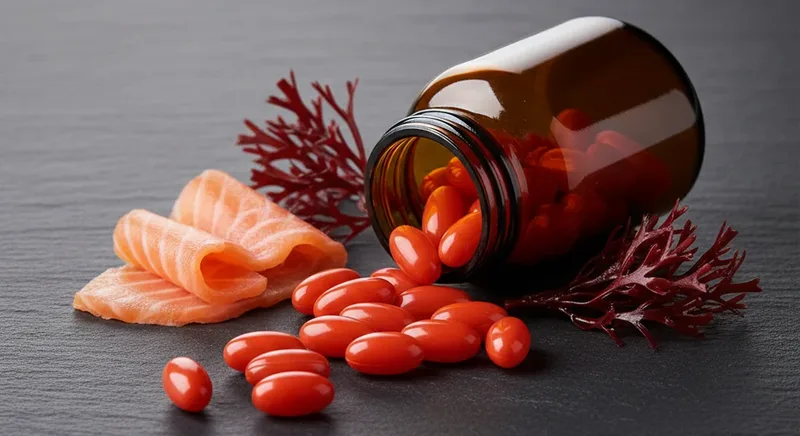
Astaxanthin is a red-colored carotenoid extracted from the microalga Haematococcus pluvialis. This alga usually grows where sunlight is especially intense, and astaxanthin is what protects it from that radiation.
For its ability to protect cell membranes, astaxanthin is more than 65 times stronger than vitamin C and 50 times stronger than vitamin E.
And for neutralising free radicals, astaxanthin is an astonishing 6,000 times stronger than vitamin C.
Because of its structure, astaxanthin gives the cell membrane unique protection from oxidative stress, shielding it from both sides (the water side and the fat side) — unlike most antioxidants, which work only on the inner side (vitamin E and beta-carotene) or the outer side (vitamin C) of the membrane.
The benefits of astaxanthin
Anti-aging benefits. Studies show astaxanthin protects the mitochondria 1,000 times more effectively than vitamin E. It reduces free-radical DNA damage and premature cell death. Because astaxanthin freely crosses the blood-brain barrier, it has a neuroprotective effect and eases eye fatigue.

The skin is the body’s largest organ, made of several layers, each with unique and important functions. Natural astaxanthin can optimise skin health and radiance, protecting and supporting all the layers. Its clinical benefits for skin: reduces inflammation in all skin layers and rejuvenates aged skin; reduces the size of wrinkles and improves skin micro-texture; improves skin elasticity and strengthens the collagen layer.

Astaxanthin supports muscle function and improves muscular endurance. In studies, natural astaxanthin was found to reduce lactic-acid build-up and reduce fatigue. Benefits for muscle activity: increases muscle endurance and recovery; reduces fatigue; reduces muscle inflammation and damage; improves blood flow and red-blood-cell quality; by improving mitochondrial function, it strengthens fat metabolism.

Astaxanthin can help improve cardiovascular health. Studies have shown that natural astaxanthin reduces oxidative stress and inflammation, improves the lipid profile and promotes better blood flow in the capillaries. Benefits for the circulatory system: improves the lipid profile; reduces oxidative stress; improves blood flow in the capillaries.

Various clinical studies have shown that astaxanthin supplements can boost capillary blood flow and improve the quality of vision. Astaxanthin benefits for the eyes: may reduce eye fatigue; may help with blurred vision; may reduce eye irritation.

Like other parts of the body, the immune system works better when it is protected. Natural astaxanthin can both balance and strengthen your immune system. This unique antioxidant improves the body’s ability to defend itself while also dampening overactive immune responses that cause unwanted inflammation. Astaxanthin is well suited to autoimmune conditions. It is also recommended for detoxification or after chemotherapy, since it neutralises free radicals. Benefits for immunity: a faster immune response; strengthens and balances the immune system; strengthens antibody production; protects immune cells from oxidative damage.

The digestive system is one of the body’s most sensitive systems. Clinical studies have shown that astaxanthin supplements can reduce stomach inflammation, protect against stomach ulcers and reduce H. pylori infection. Benefits for the digestive system: reduces inflammation in the stomach; reduces Helicobacter pylori infection; reduces clinical symptoms in dyspepsia patients.

Studies have shown astaxanthin has a range of biological effects on the brain. Randomised, double-blind, placebo-controlled trials showed that 3 months of natural astaxanthin extract from Haematococcus pluvialis improved mental speed, multitasking and memory in older people complaining of age-related forgetfulness. Astaxanthin benefits for the brain: improves alertness and reduces age-related forgetfulness; reduces red-blood-cell oxidation (dementia prevention); improves capillary blood flow and the antioxidant quality of the blood; regulates blood pressure, reduces stroke risk and improves vascular endothelial function.
Astaxanthin, immunity and oncology support
Because astaxanthin is studied for protecting immune cells from oxidative damage and for supporting a balanced immune response, it is one of the components combined in concentrated immune-support formulas during oncological disease. Its role there is as an antioxidant partner to the mushroom polysaccharides — protecting the very immune cells (such as NK cells) that the polysaccharides are studied for activating.
Lentinan AXT from Zenius Labs™ is a formula combining 6 mg of natural astaxanthin from Haematococcus pluvialis (the highest dose permitted in the EU) with clinically studied medicinal-mushroom polysaccharide extracts. Lentinan is one of the strongest known natural immunomodulators, used for decades in Japan and South Korea. The formula works on antioxidant defense, immune balance and cell recovery at the same time.
What to know before buying
Only extracts from Haematococcus pluvialis are used. Be sure the astaxanthin is of natural origin (not synthetic) — this must be written on the packaging. Synthetic astaxanthin (also used to color farmed salmon) may have side effects. In clinical studies (of natural astaxanthin), the most common dose used is 12 mg per day. The recommended duration of use is 3 months.
Frequently Asked Questions
Astaxanthin is a red carotenoid antioxidant extracted from the microalga Haematococcus pluvialis, which produces it to protect its own cells from intense UV damage. Its unique structure is studied as making it hundreds of times stronger than many other antioxidants.
For protecting cell membranes it is studied as more than 65 times stronger than vitamin C and 50 times stronger than vitamin E, and it uniquely protects the membrane from both the water and fat sides.
It is studied for anti-aging (mitochondrial and DNA protection), skin health, muscle endurance and recovery, cardiovascular support (lipid profile, circulation), eye fatigue, and immune support (faster response, antibody production, protecting immune cells).
Natural astaxanthin from Haematococcus pluvialis is studied as superior to synthetic (often petrochemical-derived) astaxanthin, which has a different molecular configuration. As a fat-soluble compound, it is best absorbed with a meal containing fat.
- Lipid profile and glucose changes after supplementation with astaxanthin: a systematic review and meta-analysis. PubMed
- Astaxanthin improved acute and chronic digital eye strain in children: A randomized double-blind placebo-controlled trial. PubMed
- Astaxanthin Protects Dendritic Cells from Lipopolysaccharide-Induced Immune Dysfunction. PubMed
- Astaxanthin and β-carotene in Helicobacter pylori-induced Gastric Inflammation. PubMed
- Astaxanthin attenuates hepatic damage and mitochondrial dysfunction in non-alcoholic fatty liver disease. PubMed
- Astaxanthin protects oxidative stress mediated DNA damage and enhances longevity. PubMed
- Astaxanthin as a neuroprotective modulator of synaptic plasticity, learning, and memory. PubMed
- Wang Y et al. Systematic review and meta-analysis on the efficacy and safety of Injectable Lentinan combined with chemotherapy in the treatment of gastric cancer. Phytomedicine : international journal of phytotherapy and phytopharmacology. 2024. PubMed
- Oba K et al. Individual patient based meta-analysis of lentinan for unresectable/recurrent gastric cancer. Anticancer research. 2009. PubMed
- Wang Y et al. Investigation on the efficiency of lentinan for injection combining cisplatin on treating malignant pleural effusion based on systematic review and meta-analysis. Medicine. 2024. PubMed
- Zhang M et al. Mushroom polysaccharide lentinan for treating different types of cancers: A review of 12 years clinical studies in China. Progress in molecular biology and translational science. 2019. PubMed
- Yin X et al. A meta-analysis of lentinan injection combined with chemotherapy in the treatment of nonsmall cell lung cancer. Indian journal of cancer. 2015. PubMed
- Baral B Holistic Evaluation of Shiitake mushrooms (Lentinula edodes): Unraveling Its Medicinal and Therapeutic Potentials. Chemistry & biodiversity. 2025. PubMed
- Ooi SL et al. Modified Rice Bran Arabinoxylan by Lentinus edodes Mycelial Enzyme as an Immunoceutical for Health and Aging-A Comprehensive Literature Review. Molecules (Basel, Switzerland). 2023. PubMed
- Choi JY et al. Dietary supplementation with rice bran fermented with Lentinus edodes increases interferon-γ activity without causing adverse effects: a randomized, double-blind, placebo-controlled, parallel-group study. Nutrition journal. 2014. PubMed
- Gaullier JM et al. Supplementation with a soluble β-glucan exported from Shiitake medicinal mushroom, Lentinus edodes (Berk.) singer mycelium: a crossover, placebo-controlled study in healthy elderly. International journal of medicinal mushrooms. 2011. PubMed
- Lu H et al. TLR2 agonist PSK activates human NK cells and enhances the antitumor effect of HER2-targeted monoclonal antibody therapy. Clinical cancer research : an official journal of the American Association for Cancer Research. 2011. PubMed
- Ooshiro M et al. [Ten cases of advanced gastro-intestinal cancer that required preoperative dosage of PSK]. Gan to kagaku ryoho. Cancer & chemotherapy. 2009. PubMed
- Tanaka H et al. Impact of adjuvant immunochemotherapy using protein-bound polysaccharide-K on overall survival of patients with gastric cancer. Anticancer research. 2012. PubMed
- Maehara Y et al. Postoperative PSK and OK-432 immunochemotherapy for patients with gastric cancer. Cancer chemotherapy and pharmacology. 1993. PubMed
- Ito G et al. Correlation between efficacy of PSK postoperative adjuvant immunochemotherapy for gastric cancer and expression of MHC class I. Experimental and therapeutic medicine. 2012. PubMed
- Standish LJ et al. Trametes versicolor mushroom immune therapy in breast cancer. Journal of the Society for Integrative Oncology. 2008. PubMed
- Eliza WL et al. Efficacy of Yun Zhi (Coriolus versicolor) on survival in cancer patients: systematic review and meta-analysis. Recent patents on inflammation & allergy drug discovery. 2012. PubMed
- He Z et al. Polysaccharide-Peptide from Trametes versicolor: The Potential Medicine for Colorectal Cancer Treatment. Biomedicines. 2022. PubMed
- Chang Y et al. Preclinical and clinical studies of Coriolus versicolor polysaccharopeptide as an immunotherapeutic in China. Discovery medicine. 2017. PubMed
- Ziaja-Sołtys M et al. Exploring the Anticancer Potential of Coriolus versicolor in Breast Cancer: A Review. Current issues in molecular biology. 2025. PubMed
- Park JS et al. Astaxanthin decreased oxidative stress and inflammation and enhanced immune response in humans. Nutrition & metabolism. 2010. PubMed
- Cheng J et al. The Promising Effects of Astaxanthin on Lung Diseases. Advances in nutrition (Bethesda, Md.). 2021. PubMed
- Lee J et al. Anti-Oxidant and Anti-Inflammatory Effects of Astaxanthin on Gastrointestinal Diseases. International journal of molecular sciences. 2022. PubMed
- Wang T et al. Astaxanthin protected against the adverse effects induced by diesel exhaust particulate matter via improving membrane stability and anti-oxidative property. Journal of hazardous materials. 2023. PubMed
- He J et al. Astaxanthin Alleviates Oxidative Stress in Mouse Preantral Follicles and Enhances Follicular Development Through the AMPK Signaling Pathway. International journal of molecular sciences. 2025. PubMed
- Akramiene D et al. Effects of beta-glucans on the immune system. Medicina (Kaunas, Lithuania). 2007. PubMed
- Ross GD et al. Therapeutic intervention with complement and beta-glucan in cancer. Immunopharmacology. 1999. PubMed
- Li B et al. Yeast beta-glucan amplifies phagocyte killing of iC3b-opsonized tumor cells via complement receptor 3-Syk-phosphatidylinositol 3-kinase pathway. Journal of immunology (Baltimore, Md. : 1950). 2006. PubMed
- Liu J et al. Combined yeast-derived beta-glucan with anti-tumor monoclonal antibody for cancer immunotherapy. Experimental and molecular pathology. 2009. PubMed
- Xia Y et al. The beta-glucan-binding lectin site of mouse CR3 (CD11b/CD18) and its function in generating a primed state of the receptor that mediates cytotoxic activation in response to iC3b-opsonized target cells. Journal of immunology (Baltimore, Md. : 1950). 1999. PubMed
- Fang J et al. Structure of a β-glucan from Grifola frondosa and its antitumor effect by activating Dectin-1/Syk/NF-κB signaling. Glycoconjugate journal. 2012. PubMed
- Zhang M et al. β-Glucan from Saccharomyces cerevisiae induces SBD-1 production in ovine ruminal epithelial cells via the Dectin-1-Syk-NF-κB signaling pathway. Cellular signalling. 2019. PubMed
- Gringhuis SI et al. Dectin-1 directs T helper cell differentiation by controlling noncanonical NF-kappaB activation through Raf-1 and Syk. Nature immunology. 2009. PubMed
- Jia XM et al. CARD9 mediates Dectin-1-induced ERK activation by linking Ras-GRF1 to H-Ras for antifungal immunity. The Journal of experimental medicine. 2014. PubMed
- Bode K et al. Dectin-1 Binding to Annexins on Apoptotic Cells Induces Peripheral Immune Tolerance via NADPH Oxidase-2. Cell reports. 2019. PubMed
- Zou X et al. Radioprotective effect of edible and medicinal mushrooms against ionizing radiation: Components, potential mechanisms, and applications. Food research international (Ottawa, Ont.). 2025. PubMed
- Dan A et al. Therapeutic Effects of Medicinal Mushrooms on Gastric, Breast, and Colorectal Cancer: A Scoping Review. Cureus. 2023. PubMed
- Abidin MHZ et al. Antiatherogenic Potential of Extracts from the Gray Oyster Medicinal Mushroom, Pleurotus pulmonarius (Agaricomycetes), In Vitro. International journal of medicinal mushrooms. 2018. PubMed
- Zhang X et al. Edible mushroom polysaccharides: Structural characteristics, chemical modification strategies, and structure-activity relationship: A review. International journal of biological macromolecules. 2025. PubMed
- Narayanan S et al. Medicinal Mushroom Supplements in Cancer: A Systematic Review of Clinical Studies. Current oncology reports. 2023. PubMed
- Wang H et al. Efficacy of biological response modifier lentinan with chemotherapy for advanced cancer: a meta-analysis. Cancer medicine. 2017. PubMed
- Oba K et al. Efficacy of adjuvant immunochemotherapy with polysaccharide K for patients with curative resections of gastric cancer. Cancer immunology, immunotherapy : CII. 2007. PubMed
- Cheng SC et al. mTOR- and HIF-1α-mediated aerobic glycolysis as metabolic basis for trained immunity. Science (New York, N.Y.). 2014. PubMed
- Kidd P Astaxanthin, cell membrane nutrient with diverse clinical benefits and anti-aging potential. Alternative medicine review : a journal of clinical therapeutic. 2011. PubMed