- Il tumore al polmone viene stadiato secondo il sistema TNM: T — dimensioni del tumore, N — linfonodi, M — metastasi
- Esistono stadi da 0 a IVB — più alto è lo stadio, più il cancro si è diffuso
- Il tumore polmonare a piccole cellule (SCLC) si suddivide in limitato ed esteso
- Quanto prima viene individuata la malattia, migliori sono la prognosi e le opzioni di trattamento
Il tumore al polmone viene classificato secondo il sistema TNM: T – dimensioni del tumore, N – linfonodi, M – metastasi. Esistono stadi da 0 a IVB; più alto è lo stadio, più il cancro si è diffuso. Il tumore polmonare a piccole cellule (SCLC) si suddivide in limitato ed esteso. Quanto prima viene individuata la malattia, migliori sono la prognosi e le opzioni di trattamento.
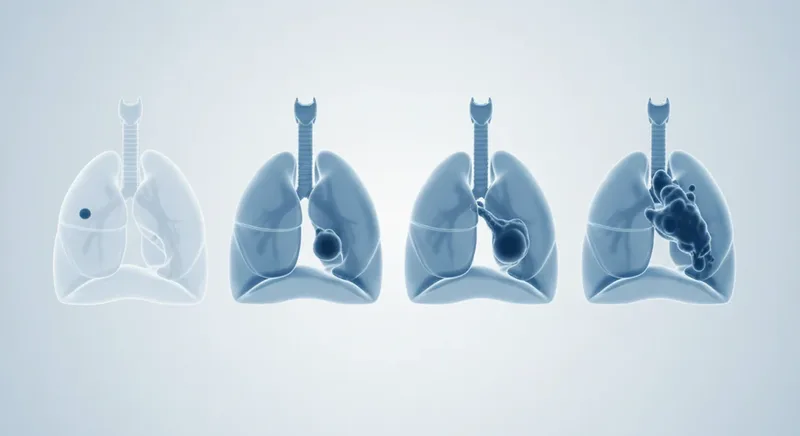
Classificazione TNM del tumore al polmone (8ª edizione, 2017)
Il sistema TNM è lo standard applicato a livello internazionale per descrivere il tumore al polmone. Ogni lettera riflette un aspetto diverso: T il tumore primario, N lo stato dei linfonodi, M le metastasi a distanza.1
T — tumore primario
- TX: il tumore primario non può essere valutato, o è confermato solo dalla presenza di cellule maligne nell'espettorato o nel lavaggio bronchiale.
- T0: nessun tumore primario. Tis: carcinoma in situ.
- T1: tumore ≤3 cm, circondato da polmone o pleura viscerale (T1a ≤1 cm; T1b >1–2 cm; T1c >2–3 cm).
- T2: tumore >3–5 cm, o che coinvolge il bronco principale, infiltra la pleura viscerale o è associato ad atelettasia (T2a >3–4 cm; T2b >4–5 cm).
- T3: tumore >5–7 cm, o che infiltra la parete toracica, il nervo frenico, la pleura mediastinica o il pericardio parietale; o noduli separati nello stesso lobo.
- T4: tumore >7 cm, o che infiltra il diaframma, il mediastino, il cuore, i grandi vasi, la trachea, l'esofago o le vertebre; o noduli in un lobo diverso.
N — metastasi nei linfonodi regionali
- NX: non valutabili. N0: nessuna metastasi.
- N1: metastasi nei linfonodi peribronchiali, ilari o intrapolmonari dello stesso lato.
- N2: metastasi nei linfonodi mediastinici o sottocarenali dello stesso lato.
- N3: metastasi nei linfonodi mediastinici/ilari del lato opposto, o in qualsiasi linfonodo sovraclaveare.
M — metastasi a distanza
M0: nessuna metastasi a distanza. M1: metastasi a distanza presenti (M1a all'interno del torace; M1b una singola metastasi a distanza; M1c metastasi a distanza multiple).
Tumore polmonare a piccole cellule (SCLC) — stadi
L'SCLC viene stadiato più semplicemente in due categorie: limitato (confinato a un lato del torace, trattabile all'interno di un singolo campo di radioterapia) ed esteso (diffuso oltre un lato del torace o a organi distanti).
La chemioterapia e la radioterapia sopprimono l'immunità. I polisaccaridi concentrati di funghi sono studiati per l'attivazione delle cellule NK e dei macrofagi.
Lentinan AXT di Zenius Labs™ →Domande frequenti
Tramite il sistema TNM (8ª edizione, 2017): T (dimensioni e invasione del tumore), N (linfonodi regionali), M (metastasi a distanza). Questi si combinano negli stadi 0–IVB. Il tumore polmonare a piccole cellule viene stadiato più semplicemente come limitato o esteso.
Il SCLC in stadio limitato è confinato a un lato del torace e trattabile all'interno di un unico campo di radioterapia. Il SCLC in stadio esteso si è diffuso oltre un lato del torace o ad organi distanti.
Quanto prima viene scoperta la malattia, tanto migliori sono la prognosi e le opzioni di trattamento. Lo stadio determina se è appropriato l'intervento chirurgico, la chemioradioterapia combinata o il trattamento sistemico.
Sì. La chemioterapia e la radioterapia sopprimono il sistema immunitario. Le formule concentrate di polisaccaridi di funghi come Lentinan AXT di Zenius Labs™ sono studiate per l'attivazione delle cellule NK e dei macrofagi.
- Yin X et al. A meta-analysis of lentinan injection combined with chemotherapy in the treatment of nonsmall cell lung cancer. Indian journal of cancer. 2015. PubMed
- Zhao C et al. Lentinan combined with cisplatin for the treatment of non-small cell lung cancer. Medicine. 2021. PubMed
- Li M et al. Lentinan triggers oxidative stress-mediated anti-inflammatory responses in lung cancer cells. Molecular and cellular biochemistry. 2022. PubMed
- Gui Y et al. Oridonin improves the therapeutic effect of lentinan on lung cancer. Experimental and therapeutic medicine. 2021. PubMed
- Wang Y et al. Investigation on the efficiency of lentinan for injection combining cisplatin on treating malignant pleural effusion based on systematic review and meta-analysis. Medicine. 2024. PubMed
- Song Z et al. Translational Nanotherapeutics Reprograms Immune Microenvironment in Malignant Pleural Effusion of Lung Adenocarcinoma. Advanced healthcare materials. 2021. PubMed
- Congcong Q et al. Evaluation of Efficacy and Safety for Lentinan in the Control of the Malignant Pleural Effusions via Intrapleural Injection. The American journal of the medical sciences. 2019. PubMed
- Ansell SM et al. PD-1 blockade with nivolumab in relapsed or refractory Hodgkin’s lymphoma. The New England journal of medicine. 2015. PubMed
- Goodman A et al. PD-1-PD-L1 immune-checkpoint blockade in B-cell lymphomas. Nature reviews. Clinical oncology. 2017. PubMed
- Zak J et al. JAK inhibition enhances checkpoint blockade immunotherapy in patients with Hodgkin lymphoma. Science (New York, N.Y.). 2024. PubMed
- Chen H et al. Integrative spatial analysis reveals tumor heterogeneity and immune colony niche related to clinical outcomes in small cell lung cancer. Cancer cell. 2025. PubMed
- Redin E et al. Dasatinib Remodels the Tumor Microenvironment and Sensitizes Small Cell Lung Cancer to Immunotherapy. Cancer research. 2025. PubMed
- Tani M et al. In vitro generation of activated natural killer cells and cytotoxic macrophages with lentinan. European journal of clinical pharmacology. 1992. PubMed
- Hamano K et al. The preoperative administration of lentinan ameliorated the impairment of natural killer activity after cardiopulmonary bypass. International journal of immunopharmacology. 1999. PubMed
- Mattiola I et al. The macrophage tetraspan MS4A4A enhances dectin-1-dependent NK cell-mediated resistance to metastasis. Nature immunology. 2019. PubMed
- Chandrakesan P et al. DCLK1-Isoform2 Alternative Splice Variant Promotes Pancreatic Tumor Immunosuppressive M2-Macrophage Polarization. Molecular cancer therapeutics. 2020. PubMed
- Fan TW et al. Polarization and β-Glucan Reprogram Immunomodulatory Metabolism in Human Macrophages and Ex Vivo in Human Lung Cancer Tissues. Journal of immunology (Baltimore, Md. : 1950). 2022. PubMed
- Fang J et al. Structure of a β-glucan from Grifola frondosa and its antitumor effect by activating Dectin-1/Syk/NF-κB signaling. Glycoconjugate journal. 2012. PubMed
- Zhang M et al. β-Glucan from Saccharomyces cerevisiae induces SBD-1 production in ovine ruminal epithelial cells via the Dectin-1-Syk-NF-κB signaling pathway. Cellular signalling. 2019. PubMed
- Gringhuis SI et al. Dectin-1 directs T helper cell differentiation by controlling noncanonical NF-kappaB activation through Raf-1 and Syk. Nature immunology. 2009. PubMed
- Ooshiro M et al. [Ten cases of advanced gastro-intestinal cancer that required preoperative dosage of PSK]. Gan to kagaku ryoho. Cancer & chemotherapy. 2009. PubMed
- Maehara Y et al. Postoperative PSK and OK-432 immunochemotherapy for patients with gastric cancer. Cancer chemotherapy and pharmacology. 1993. PubMed
- Ito G et al. Correlation between efficacy of PSK postoperative adjuvant immunochemotherapy for gastric cancer and expression of MHC class I. Experimental and therapeutic medicine. 2012. PubMed
- Cheng J et al. The Promising Effects of Astaxanthin on Lung Diseases. Advances in nutrition (Bethesda, Md.). 2021. PubMed
- Wu C et al. [Astaxanthin inhibits proliferation and promotes apoptosis of A549 lung cancer cells via blocking JAK1/STAT3 pathway]. Xi bao yu fen zi mian yi xue za zhi = Chinese journal of cellular and molecular immunology. 2016. PubMed
- Qian J et al. Molecular mechanisms underlying the beneficial effects of Astaxanthin on metabolic changes in lung cancer and diabetes mellitus: A dual pathophysiological perspective. International immunopharmacology. 2025. PubMed
- Park JS et al. Astaxanthin decreased oxidative stress and inflammation and enhanced immune response in humans. Nutrition & metabolism. 2010. PubMed
- Lee J et al. Anti-Oxidant and Anti-Inflammatory Effects of Astaxanthin on Gastrointestinal Diseases. International journal of molecular sciences. 2022. PubMed
- Wang T et al. Astaxanthin protected against the adverse effects induced by diesel exhaust particulate matter via improving membrane stability and anti-oxidative property. Journal of hazardous materials. 2023. PubMed
- Deng S et al. Lentinan inhibits tumor angiogenesis via interferon γ and in a T cell independent manner. Journal of experimental & clinical cancer research : CR. 2018. PubMed
- Deng S et al. Correction to: Lentinan inhibits tumor angiogenesis via interferon γ and in a T cell independent manner. Journal of experimental & clinical cancer research : CR. 2021. PubMed
- Wang H et al. Efficacy of biological response modifier lentinan with chemotherapy for advanced cancer: a meta-analysis. Cancer medicine. 2017. PubMed
- Zhang Y et al. Lentinan as an immunotherapeutic for treating lung cancer: a review of 12 years clinical studies in China. Journal of cancer research and clinical oncology. 2018. PubMed
- Wang XE et al. Immunomodulatory Effect of Lentinan on Aberrant T Subsets and Cytokines Profile in Non-small Cell Lung Cancer Patients. Pathology oncology research : POR. 2020. PubMed
- Wang Y et al. Systematic review and meta-analysis on the efficacy and safety of Injectable Lentinan combined with chemotherapy in the treatment of gastric cancer. Phytomedicine : international journal of phytotherapy and phytopharmacology. 2024. PubMed
- Oba K et al. Efficacy of adjuvant immunochemotherapy with polysaccharide K for patients with curative resections of gastric cancer. Cancer immunology, immunotherapy : CII. 2007. PubMed
- Cheng SC et al. mTOR- and HIF-1α-mediated aerobic glycolysis as metabolic basis for trained immunity. Science (New York, N.Y.). 2014. PubMed
- Kidd P Astaxanthin, cell membrane nutrient with diverse clinical benefits and anti-aging potential. Alternative medicine review : a journal of clinical therapeutic. 2011. PubMed