- Longkanker wordt ingedeeld volgens het TNM-systeem: T — tumorgrootte, N — lymfeklieren, M — metastasen
- Er zijn stadia 0–IVB — hoe hoger het stadium, hoe verder de kanker zich heeft verspreid
- Kleincellige longkanker (SCLC) wordt onderverdeeld in beperkt en uitgebreid
- Hoe eerder de ziekte wordt ontdekt, hoe beter de prognose en hoe meer behandelingsopties er zijn
Longkanker wordt geclassificeerd volgens het TNM-systeem: T – tumorgrootte, N – lymfeklieren, M – metastasen. Er zijn stadia 0–IVB; hoe hoger het stadium, hoe verder de kanker zich heeft verspreid. Kleincellige longkanker (SCLC) wordt onderverdeeld in beperkt en uitgebreid. Hoe eerder de ziekte wordt gevonden, hoe beter de prognose en hoe meer behandelingsopties er zijn.
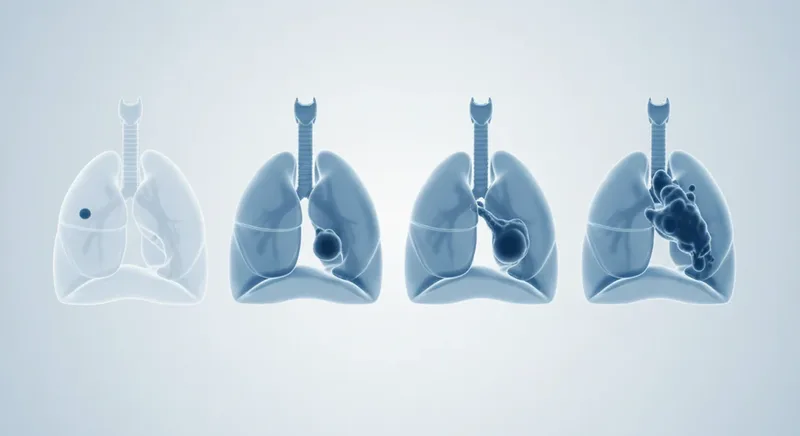
TNM-classificatie van longkanker (8e editie, 2017)
Het TNM-systeem is de internationaal toegepaste standaard voor het beschrijven van longkanker. Elke letter weerspiegelt een ander aspect: T de primaire tumor, N de status van de lymfeklieren, M metastasen op afstand.1
T — primaire tumor
- TX: de primaire tumor kan niet worden beoordeeld, of wordt alleen bevestigd door kwaadaardige cellen in sputum of bronchiale spoelingen.
- T0: geen primaire tumor. Tis: carcinoma in situ.
- T1: tumor ≤3 cm, omgeven door long of visceraal longvlies (T1a ≤1 cm; T1b >1–2 cm; T1c >2–3 cm).
- T2: tumor >3–5 cm, of met ingroei in de hoofdbronchus, infiltratie van het viscerale longvlies, of geassocieerd met atelectase (T2a >3–4 cm; T2b >4–5 cm).
- T3: tumor >5–7 cm, of met infiltratie van de borstwand, nervus phrenicus, mediastinale pleura of pariëtale pericard; of afzonderlijke noduli in dezelfde kwab.
- T4: tumor >7 cm, of met infiltratie van het diafragma, mediastinum, hart, grote vaten, trachea, slokdarm of wervels; of noduli in een andere kwab.
N — metastasen in regionale lymfeklieren
- NX: kan niet worden beoordeeld. N0: geen metastasen.
- N1: metastasen in peribronchiale, hilaire of intrapulmonale klieren aan dezelfde zijde.
- N2: metastasen in mediastinale of subcarinale klieren aan dezelfde zijde.
- N3: metastasen in mediastinale/hilaire klieren aan de andere zijde, of in supraclaviculaire klieren (ongeacht welke zijde).
M — metastasen op afstand
M0: geen metastasen op afstand. M1: metastasen op afstand aanwezig (M1a binnen de borstkas; M1b een enkele metastase op afstand; M1c meerdere metastasen op afstand).
Kleincellige longkanker (SCLC) — stadia
SCLC wordt eenvoudiger ingedeeld in twee categorieën: beperkt (beperkt tot één kant van de borstkas, behandelbaar binnen één enkel radiotherapieveld) en uitgebreid (verspreid buiten één kant van de borstkas of naar organen op afstand).
Chemotherapie en radiotherapie onderdrukken de immuniteit. Geconcentreerde polysachariden uit paddenstoelen worden bestudeerd voor het activeren van NK-cellen en macrofagen.
Lentinan AXT van Zenius Labs™ →Veelgestelde vragen
Volgens het TNM-systeem (8e editie, 2017): T (tumorgrootte en -invasie), N (regionale lymfeklieren), M (metastasen op afstand). Deze worden gecombineerd tot stadia 0–IVB. Kleincellige longkanker wordt eenvoudiger gestadieerd als beperkt of uitgebreid.
Beperkte SCLC is beperkt tot één kant van de borstkas en kan worden behandeld binnen één enkel radiotherapieveld. Uitgebreide SCLC heeft zich verspreid buiten één kant van de borstkas of naar verre organen.
Hoe vroeger de ziekte wordt ontdekt, hoe beter de prognose en hoe meer behandelingsopties er zijn. Het stadium bepaalt of een operatie, gecombineerde chemoradiotherapie of systemische behandeling aangewezen is.
Ja. Chemotherapie en radiotherapie onderdrukken het immuunsysteem. Geconcentreerde paddenstoel-polysacharideformules zoals Lentinan AXT van Zenius Labs™ worden bestudeerd voor het activeren van NK-cellen en macrofagen.
- Yin X et al. A meta-analysis of lentinan injection combined with chemotherapy in the treatment of nonsmall cell lung cancer. Indian journal of cancer. 2015. PubMed
- Zhao C et al. Lentinan combined with cisplatin for the treatment of non-small cell lung cancer. Medicine. 2021. PubMed
- Li M et al. Lentinan triggers oxidative stress-mediated anti-inflammatory responses in lung cancer cells. Molecular and cellular biochemistry. 2022. PubMed
- Gui Y et al. Oridonin improves the therapeutic effect of lentinan on lung cancer. Experimental and therapeutic medicine. 2021. PubMed
- Wang Y et al. Investigation on the efficiency of lentinan for injection combining cisplatin on treating malignant pleural effusion based on systematic review and meta-analysis. Medicine. 2024. PubMed
- Song Z et al. Translational Nanotherapeutics Reprograms Immune Microenvironment in Malignant Pleural Effusion of Lung Adenocarcinoma. Advanced healthcare materials. 2021. PubMed
- Congcong Q et al. Evaluation of Efficacy and Safety for Lentinan in the Control of the Malignant Pleural Effusions via Intrapleural Injection. The American journal of the medical sciences. 2019. PubMed
- Ansell SM et al. PD-1 blockade with nivolumab in relapsed or refractory Hodgkin’s lymphoma. The New England journal of medicine. 2015. PubMed
- Goodman A et al. PD-1-PD-L1 immune-checkpoint blockade in B-cell lymphomas. Nature reviews. Clinical oncology. 2017. PubMed
- Zak J et al. JAK inhibition enhances checkpoint blockade immunotherapy in patients with Hodgkin lymphoma. Science (New York, N.Y.). 2024. PubMed
- Chen H et al. Integrative spatial analysis reveals tumor heterogeneity and immune colony niche related to clinical outcomes in small cell lung cancer. Cancer cell. 2025. PubMed
- Redin E et al. Dasatinib Remodels the Tumor Microenvironment and Sensitizes Small Cell Lung Cancer to Immunotherapy. Cancer research. 2025. PubMed
- Tani M et al. In vitro generation of activated natural killer cells and cytotoxic macrophages with lentinan. European journal of clinical pharmacology. 1992. PubMed
- Hamano K et al. The preoperative administration of lentinan ameliorated the impairment of natural killer activity after cardiopulmonary bypass. International journal of immunopharmacology. 1999. PubMed
- Mattiola I et al. The macrophage tetraspan MS4A4A enhances dectin-1-dependent NK cell-mediated resistance to metastasis. Nature immunology. 2019. PubMed
- Chandrakesan P et al. DCLK1-Isoform2 Alternative Splice Variant Promotes Pancreatic Tumor Immunosuppressive M2-Macrophage Polarization. Molecular cancer therapeutics. 2020. PubMed
- Fan TW et al. Polarization and β-Glucan Reprogram Immunomodulatory Metabolism in Human Macrophages and Ex Vivo in Human Lung Cancer Tissues. Journal of immunology (Baltimore, Md. : 1950). 2022. PubMed
- Fang J et al. Structure of a β-glucan from Grifola frondosa and its antitumor effect by activating Dectin-1/Syk/NF-κB signaling. Glycoconjugate journal. 2012. PubMed
- Zhang M et al. β-Glucan from Saccharomyces cerevisiae induces SBD-1 production in ovine ruminal epithelial cells via the Dectin-1-Syk-NF-κB signaling pathway. Cellular signalling. 2019. PubMed
- Gringhuis SI et al. Dectin-1 directs T helper cell differentiation by controlling noncanonical NF-kappaB activation through Raf-1 and Syk. Nature immunology. 2009. PubMed
- Ooshiro M et al. [Ten cases of advanced gastro-intestinal cancer that required preoperative dosage of PSK]. Gan to kagaku ryoho. Cancer & chemotherapy. 2009. PubMed
- Maehara Y et al. Postoperative PSK and OK-432 immunochemotherapy for patients with gastric cancer. Cancer chemotherapy and pharmacology. 1993. PubMed
- Ito G et al. Correlation between efficacy of PSK postoperative adjuvant immunochemotherapy for gastric cancer and expression of MHC class I. Experimental and therapeutic medicine. 2012. PubMed
- Cheng J et al. The Promising Effects of Astaxanthin on Lung Diseases. Advances in nutrition (Bethesda, Md.). 2021. PubMed
- Wu C et al. [Astaxanthin inhibits proliferation and promotes apoptosis of A549 lung cancer cells via blocking JAK1/STAT3 pathway]. Xi bao yu fen zi mian yi xue za zhi = Chinese journal of cellular and molecular immunology. 2016. PubMed
- Qian J et al. Molecular mechanisms underlying the beneficial effects of Astaxanthin on metabolic changes in lung cancer and diabetes mellitus: A dual pathophysiological perspective. International immunopharmacology. 2025. PubMed
- Park JS et al. Astaxanthin decreased oxidative stress and inflammation and enhanced immune response in humans. Nutrition & metabolism. 2010. PubMed
- Lee J et al. Anti-Oxidant and Anti-Inflammatory Effects of Astaxanthin on Gastrointestinal Diseases. International journal of molecular sciences. 2022. PubMed
- Wang T et al. Astaxanthin protected against the adverse effects induced by diesel exhaust particulate matter via improving membrane stability and anti-oxidative property. Journal of hazardous materials. 2023. PubMed
- Deng S et al. Lentinan inhibits tumor angiogenesis via interferon γ and in a T cell independent manner. Journal of experimental & clinical cancer research : CR. 2018. PubMed
- Deng S et al. Correction to: Lentinan inhibits tumor angiogenesis via interferon γ and in a T cell independent manner. Journal of experimental & clinical cancer research : CR. 2021. PubMed
- Wang H et al. Efficacy of biological response modifier lentinan with chemotherapy for advanced cancer: a meta-analysis. Cancer medicine. 2017. PubMed
- Zhang Y et al. Lentinan as an immunotherapeutic for treating lung cancer: a review of 12 years clinical studies in China. Journal of cancer research and clinical oncology. 2018. PubMed
- Wang XE et al. Immunomodulatory Effect of Lentinan on Aberrant T Subsets and Cytokines Profile in Non-small Cell Lung Cancer Patients. Pathology oncology research : POR. 2020. PubMed
- Wang Y et al. Systematic review and meta-analysis on the efficacy and safety of Injectable Lentinan combined with chemotherapy in the treatment of gastric cancer. Phytomedicine : international journal of phytotherapy and phytopharmacology. 2024. PubMed
- Oba K et al. Efficacy of adjuvant immunochemotherapy with polysaccharide K for patients with curative resections of gastric cancer. Cancer immunology, immunotherapy : CII. 2007. PubMed
- Cheng SC et al. mTOR- and HIF-1α-mediated aerobic glycolysis as metabolic basis for trained immunity. Science (New York, N.Y.). 2014. PubMed
- Kidd P Astaxanthin, cell membrane nutrient with diverse clinical benefits and anti-aging potential. Alternative medicine review : a journal of clinical therapeutic. 2011. PubMed