- Lung cancer is staged by the TNM system: T — tumor size, N — lymph nodes, M — metastases
- There are stages 0–IVB — the higher the stage, the more the cancer has spread
- Small-cell lung cancer (SCLC) is divided into limited and extensive
- The earlier the disease is caught, the better the prognosis and the more treatment options
Lung cancer is classified by the TNM system: T – tumor size, N – lymph nodes, M – metastases. There are stages 0–IVB; the higher the stage, the more the cancer has spread. Small-cell lung cancer (SCLC) is divided into limited and extensive. The earlier the disease is found, the better the prognosis and the more treatment options.
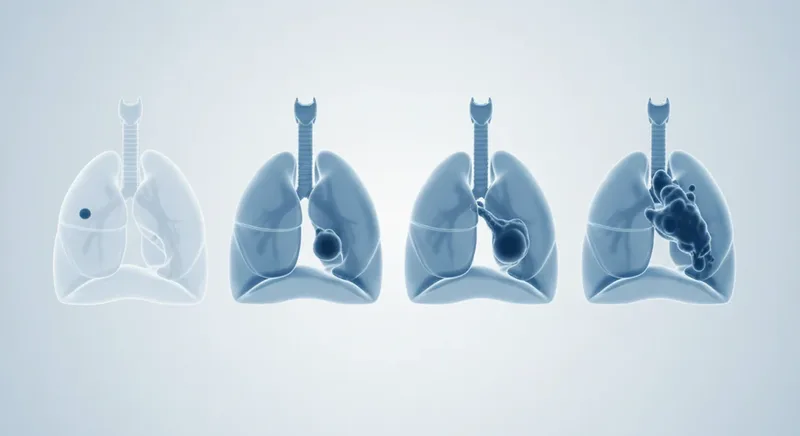
Lung cancer TNM classification (8th edition, 2017)
The TNM system is the internationally applied standard for describing lung cancer. Each letter reflects a different aspect: T the primary tumor, N the lymph-node status, M distant metastases.1
T — primary tumor
- TX: the primary tumor cannot be assessed, or is confirmed only by malignant cells in sputum or bronchial washings.
- T0: no primary tumor. Tis: carcinoma in situ.
- T1: tumor ≤3 cm, surrounded by lung or visceral pleura (T1a ≤1 cm; T1b >1–2 cm; T1c >2–3 cm).
- T2: tumor >3–5 cm, or involving the main bronchus, infiltrating visceral pleura, or associated with atelectasis (T2a >3–4 cm; T2b >4–5 cm).
- T3: tumor >5–7 cm, or infiltrating the chest wall, phrenic nerve, mediastinal pleura or parietal pericardium; or separate nodules in the same lobe.
- T4: tumor >7 cm, or infiltrating the diaphragm, mediastinum, heart, great vessels, trachea, esophagus or vertebrae; or nodules in a different lobe.
N — metastases in regional lymph nodes
- NX: cannot be assessed. N0: no metastases.
- N1: metastases in same-side peribronchial, hilar or intrapulmonary nodes.
- N2: metastases in same-side mediastinal or subcarinal nodes.
- N3: metastases in opposite-side mediastinal/hilar nodes, or any supraclavicular nodes.
M — distant metastases
M0: no distant metastases. M1: distant metastases present (M1a within the chest; M1b a single distant metastasis; M1c multiple distant metastases).
Small-cell lung cancer (SCLC) — stages
SCLC is staged more simply into two categories: limited (confined to one side of the chest, treatable within a single radiotherapy field) and extensive (spread beyond one side of the chest or to distant organs).
Chemotherapy and radiotherapy suppress immunity. Concentrated mushroom polysaccharides are studied for activating NK cells and macrophages.
Lentinan AXT by Zenius Labs™ →Frequently Asked Questions
By the TNM system (8th edition, 2017): T (tumor size and invasion), N (regional lymph nodes), M (distant metastases). These combine into stages 0–IVB. Small-cell lung cancer is staged more simply as limited or extensive.
Limited SCLC is confined to one side of the chest and treatable within a single radiotherapy field. Extensive SCLC has spread beyond one side of the chest or to distant organs.
The earlier the disease is found, the better the prognosis and the more treatment options. Stage determines whether surgery, combined chemoradiotherapy, or systemic treatment is appropriate.
Yes. Chemotherapy and radiotherapy suppress the immune system. Concentrated mushroom-polysaccharide formulas such as Lentinan AXT by Zenius Labs™ are studied for activating NK cells and macrophages.
- Yin X et al. A meta-analysis of lentinan injection combined with chemotherapy in the treatment of nonsmall cell lung cancer. Indian journal of cancer. 2015. PubMed
- Zhao C et al. Lentinan combined with cisplatin for the treatment of non-small cell lung cancer. Medicine. 2021. PubMed
- Li M et al. Lentinan triggers oxidative stress-mediated anti-inflammatory responses in lung cancer cells. Molecular and cellular biochemistry. 2022. PubMed
- Gui Y et al. Oridonin improves the therapeutic effect of lentinan on lung cancer. Experimental and therapeutic medicine. 2021. PubMed
- Wang Y et al. Investigation on the efficiency of lentinan for injection combining cisplatin on treating malignant pleural effusion based on systematic review and meta-analysis. Medicine. 2024. PubMed
- Song Z et al. Translational Nanotherapeutics Reprograms Immune Microenvironment in Malignant Pleural Effusion of Lung Adenocarcinoma. Advanced healthcare materials. 2021. PubMed
- Congcong Q et al. Evaluation of Efficacy and Safety for Lentinan in the Control of the Malignant Pleural Effusions via Intrapleural Injection. The American journal of the medical sciences. 2019. PubMed
- Ansell SM et al. PD-1 blockade with nivolumab in relapsed or refractory Hodgkin’s lymphoma. The New England journal of medicine. 2015. PubMed
- Goodman A et al. PD-1-PD-L1 immune-checkpoint blockade in B-cell lymphomas. Nature reviews. Clinical oncology. 2017. PubMed
- Zak J et al. JAK inhibition enhances checkpoint blockade immunotherapy in patients with Hodgkin lymphoma. Science (New York, N.Y.). 2024. PubMed
- Chen H et al. Integrative spatial analysis reveals tumor heterogeneity and immune colony niche related to clinical outcomes in small cell lung cancer. Cancer cell. 2025. PubMed
- Redin E et al. Dasatinib Remodels the Tumor Microenvironment and Sensitizes Small Cell Lung Cancer to Immunotherapy. Cancer research. 2025. PubMed
- Tani M et al. In vitro generation of activated natural killer cells and cytotoxic macrophages with lentinan. European journal of clinical pharmacology. 1992. PubMed
- Hamano K et al. The preoperative administration of lentinan ameliorated the impairment of natural killer activity after cardiopulmonary bypass. International journal of immunopharmacology. 1999. PubMed
- Mattiola I et al. The macrophage tetraspan MS4A4A enhances dectin-1-dependent NK cell-mediated resistance to metastasis. Nature immunology. 2019. PubMed
- Chandrakesan P et al. DCLK1-Isoform2 Alternative Splice Variant Promotes Pancreatic Tumor Immunosuppressive M2-Macrophage Polarization. Molecular cancer therapeutics. 2020. PubMed
- Fan TW et al. Polarization and β-Glucan Reprogram Immunomodulatory Metabolism in Human Macrophages and Ex Vivo in Human Lung Cancer Tissues. Journal of immunology (Baltimore, Md. : 1950). 2022. PubMed
- Fang J et al. Structure of a β-glucan from Grifola frondosa and its antitumor effect by activating Dectin-1/Syk/NF-κB signaling. Glycoconjugate journal. 2012. PubMed
- Zhang M et al. β-Glucan from Saccharomyces cerevisiae induces SBD-1 production in ovine ruminal epithelial cells via the Dectin-1-Syk-NF-κB signaling pathway. Cellular signalling. 2019. PubMed
- Gringhuis SI et al. Dectin-1 directs T helper cell differentiation by controlling noncanonical NF-kappaB activation through Raf-1 and Syk. Nature immunology. 2009. PubMed
- Ooshiro M et al. [Ten cases of advanced gastro-intestinal cancer that required preoperative dosage of PSK]. Gan to kagaku ryoho. Cancer & chemotherapy. 2009. PubMed
- Maehara Y et al. Postoperative PSK and OK-432 immunochemotherapy for patients with gastric cancer. Cancer chemotherapy and pharmacology. 1993. PubMed
- Ito G et al. Correlation between efficacy of PSK postoperative adjuvant immunochemotherapy for gastric cancer and expression of MHC class I. Experimental and therapeutic medicine. 2012. PubMed
- Cheng J et al. The Promising Effects of Astaxanthin on Lung Diseases. Advances in nutrition (Bethesda, Md.). 2021. PubMed
- Wu C et al. [Astaxanthin inhibits proliferation and promotes apoptosis of A549 lung cancer cells via blocking JAK1/STAT3 pathway]. Xi bao yu fen zi mian yi xue za zhi = Chinese journal of cellular and molecular immunology. 2016. PubMed
- Qian J et al. Molecular mechanisms underlying the beneficial effects of Astaxanthin on metabolic changes in lung cancer and diabetes mellitus: A dual pathophysiological perspective. International immunopharmacology. 2025. PubMed
- Park JS et al. Astaxanthin decreased oxidative stress and inflammation and enhanced immune response in humans. Nutrition & metabolism. 2010. PubMed
- Lee J et al. Anti-Oxidant and Anti-Inflammatory Effects of Astaxanthin on Gastrointestinal Diseases. International journal of molecular sciences. 2022. PubMed
- Wang T et al. Astaxanthin protected against the adverse effects induced by diesel exhaust particulate matter via improving membrane stability and anti-oxidative property. Journal of hazardous materials. 2023. PubMed
- Deng S et al. Lentinan inhibits tumor angiogenesis via interferon γ and in a T cell independent manner. Journal of experimental & clinical cancer research : CR. 2018. PubMed
- Deng S et al. Correction to: Lentinan inhibits tumor angiogenesis via interferon γ and in a T cell independent manner. Journal of experimental & clinical cancer research : CR. 2021. PubMed
- Wang H et al. Efficacy of biological response modifier lentinan with chemotherapy for advanced cancer: a meta-analysis. Cancer medicine. 2017. PubMed
- Zhang Y et al. Lentinan as an immunotherapeutic for treating lung cancer: a review of 12 years clinical studies in China. Journal of cancer research and clinical oncology. 2018. PubMed
- Wang XE et al. Immunomodulatory Effect of Lentinan on Aberrant T Subsets and Cytokines Profile in Non-small Cell Lung Cancer Patients. Pathology oncology research : POR. 2020. PubMed
- Wang Y et al. Systematic review and meta-analysis on the efficacy and safety of Injectable Lentinan combined with chemotherapy in the treatment of gastric cancer. Phytomedicine : international journal of phytotherapy and phytopharmacology. 2024. PubMed
- Oba K et al. Efficacy of adjuvant immunochemotherapy with polysaccharide K for patients with curative resections of gastric cancer. Cancer immunology, immunotherapy : CII. 2007. PubMed
- Cheng SC et al. mTOR- and HIF-1α-mediated aerobic glycolysis as metabolic basis for trained immunity. Science (New York, N.Y.). 2014. PubMed
- Kidd P Astaxanthin, cell membrane nutrient with diverse clinical benefits and anti-aging potential. Alternative medicine review : a journal of clinical therapeutic. 2011. PubMed