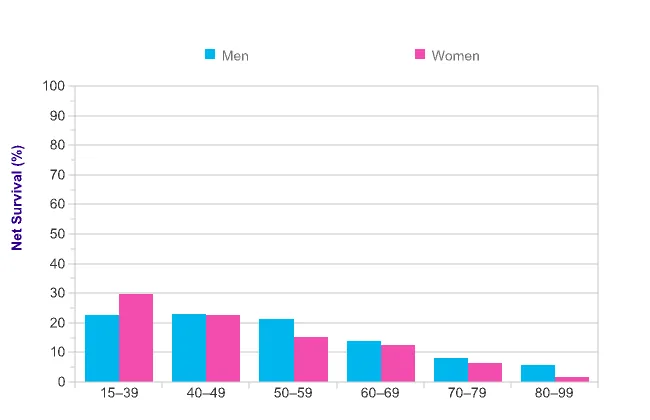
- Por edad
- Por propagación
- Por metástasis
- Cómo ayudarse a sí mismo
Las cifras de supervivencia del cáncer de hígado se basan en personas diagnosticadas entre 2011 y 2017. Recuerde que las tasas de supervivencia son aproximadas y se basan en los resultados pasados de otras personas — no pueden decirle lo que sucederá en su caso individual. Una de las razones de la baja supervivencia es que muchas personas con cáncer de hígado también tienen comorbilidades como la cirrosis hepática.
Supervivencia por extensión de la propagación
Si el cáncer de hígado no tiene metástasis, la supervivencia a cinco años es del 28 %. Si hay metástasis en el hígado y en órganos cercanos, la supervivencia a cinco años es del 7 %. Cuando el cáncer de hígado se ha extendido a órganos o tejidos más distantes, la supervivencia es aún menor. La supervivencia también depende en gran medida del tratamiento aplicado: en el caso del cáncer de hígado que puede extirparse quirúrgicamente (resecarse), el pronóstico a cinco años mejora en más de un 50 %, especialmente cuando la enfermedad se detecta en las fases más tempranas.
Metástasis
La presencia y localización de las metástasis es uno de los factores más determinantes en el pronóstico. El cáncer de hígado que permanece localizado es mucho más tratable que la enfermedad que se ha extendido a órganos cercanos o distantes, por lo que la detección precoz marca una gran diferencia en la supervivencia.
¿Qué puedo hacer en la lucha contra el cáncer de hígado?
El alcohol es tóxico para las células hepáticas, por lo que su consumo puede acelerar el daño hepático con consecuencias potencialmente mortales — será necesario abandonar el alcohol.2 Dejar de fumar alarga directamente el tiempo de supervivencia.3 La supervivencia también puede depender de lo dulce: la fructosa (fruta, zumos, dulces) es tóxica para el hígado,45 por lo que las vitaminas y los minerales deben proceder de las verduras, el pescado y los huevos.
Los hongos se han utilizado como medicina durante miles de años por su inigualable diversidad farmacológica. El Lentinan, procedente del hongo medicinal Lentinus edodes, es el compuesto anticancerígeno más exhaustivamente estudiado y documentado. Un estudio7 descubrió que el lentinan suprime el cáncer de hígado e incluso tiene "un efecto anticancerígeno sinérgico significativo" cuando se utiliza junto con la quimioterapia. Solo se utilizan extractos de polisacáridos a base de agua — los extractos a base de etanol (alcohol) son más baratos y rápidos, pero no extraen los compuestos que necesitamos. El hígado desempeña un papel central en la desintoxicación y la inmunidad, por lo que se estudia una fórmula concentrada de polisacáridos de hongos multiextracto para apoyar el sistema inmunitario y mejorar la calidad de vida durante el tratamiento.
Un estudio descubrió que el lentinan tiene un efecto anticancerígeno sinérgico significativo con la quimioterapia en el cáncer de hígado. Solo los extractos a base de agua aportan los polisacáridos activos.
Lentinan AXT de Zenius Labs™ →Preguntas frecuentes
Si el cáncer de hígado no tiene metástasis, la supervivencia a cinco años es de aproximadamente el 28 %. Con metástasis en el hígado y órganos cercanos, desciende a cerca del 7 %, y es aún menor una vez que se extiende a órganos distantes. En el caso de los cánceres que pueden resecarse quirúrgicamente, el pronóstico a cinco años mejora en más de un 50 %.
Una de las razones es que muchas personas con cáncer de hígado también tienen comorbilidades como la cirrosis hepática. La supervivencia también depende en gran medida del estadio en el momento del diagnóstico y de si el tumor puede extirparse quirúrgicamente.
El alcohol es tóxico para las células hepáticas y debe abandonarse; dejar de fumar alarga la supervivencia; y la fructosa (zumos de fruta, dulces) es tóxica para el hígado, por lo que las vitaminas y los minerales deben proceder de las verduras, el pescado y los huevos.
Un estudio descubrió que el lentinan suprime el cáncer de hígado y tiene un efecto anticancerígeno sinérgico significativo junto con la quimioterapia. Solo los extractos a base de agua aportan los polisacáridos activos. Se estudia una fórmula concentrada como Lentinan AXT de Zenius Labs™ para el apoyo inmunitario durante el tratamiento.
- Li GL et al. The anti-hepatocellular carcinoma effects of polysaccharides from Ganoderma lucidum by regulating macrophage polarization via the MAPK/NF-κB signaling pathway. Food & function. 2023. PubMed
- Yang P et al. Clinical application of a combination therapy of lentinan, multi-electrode RFA and TACE in HCC. Advances in therapy. 2008. PubMed
- Yuan Y et al. TACE-HAIC combined with targeted therapy and immunotherapy versus TACE alone for hepatocellular carcinoma with portal vein tumour thrombus: a propensity score matching study. International journal of surgery (London, England). 2023. PubMed
- Maataoui A et al. Transarterial chemoembolization alone and in combination with other therapies: a comparative study in an animal HCC model. European radiology. 2005. PubMed
- Guo N et al. Transcatheter hepatic arterial chemoembolization plus cinobufotalin injection adjuvant therapy for advanced hepatocellular carcinoma: a meta-analysis of 27 trials involving 2,079 patients. OncoTargets and therapy. 2018. PubMed
- Yang Y et al. Compound kushen injection relieves tumor-associated macrophage-mediated immunosuppression through TNFR1 and sensitizes hepatocellular carcinoma to sorafenib. Journal for immunotherapy of cancer. 2020. PubMed
- Wang C et al. Astragali radix – Curcumae rhizoma herb pair enhances Sorafenib’s efficacy by inducing ferroptosis and activates Th1 cell immune response synergistically against hepatocellular carcinoma. Phytomedicine : international journal of phytotherapy and phytopharmacology. 2025. PubMed
- Zhang QB et al. Suppression of natural killer cells by sorafenib contributes to prometastatic effects in hepatocellular carcinoma. PloS one. 2013. PubMed
- Sun Q et al. Targeting NAD(+) metabolism of hepatocellular carcinoma cells by lenvatinib promotes M2 macrophages reverse polarization, suppressing the HCC progression. Hepatology international. 2023. PubMed
- Mani SKK et al. Hepatitis B Virus-Associated Hepatocellular Carcinoma and Hepatic Cancer Stem Cells. Genes. 2018. PubMed
- Meng Y et al. Hepatitis B Virus-Mediated m6A Demethylation Increases Hepatocellular Carcinoma Stemness and Immune Escape. Molecular cancer research : MCR. 2024. PubMed
- Ortega-Prieto AM et al. Immune Evasion Strategies during Chronic Hepatitis B and C Virus Infection. Vaccines. 2017. PubMed
- Chisari FV et al. Hepatitis B virus immunopathology. Springer seminars in immunopathology. 1995. PubMed
- Meunier L et al. Chemotherapy-associated steatohepatitis. Annals of hepatology. 2020. PubMed
- Farrell GC Drugs and steatohepatitis. Seminars in liver disease. 2002. PubMed
- Huang DQ et al. Global epidemiology of NAFLD-related HCC: trends, predictions, risk factors and prevention. Nature reviews. Gastroenterology & hepatology. 2021. PubMed
- Llovet JM et al. Nonalcoholic steatohepatitis-related hepatocellular carcinoma: pathogenesis and treatment. Nature reviews. Gastroenterology & hepatology. 2023. PubMed
- Thomas SK et al. Kupffer cells prevent pancreatic ductal adenocarcinoma metastasis to the liver in mice. Nature communications. 2023. PubMed
- Pereira FE et al. Kupffer cell activation with BCG. Corynebacterium parvum or zymosan protects against acute liver injury induced by carbon tetrachloride in rats. Arquivos de gastroenterologia. 1997. PubMed
- Armbrust T et al. Functional characterization of two different Kupffer cell populations of normal rat liver. Journal of hepatology. 1996. PubMed
- Youssef J et al. Activated Kupffer cells attenuate the liver response to the peroxisome proliferator perfluorooctanoic acid. Molecular and cellular biochemistry. 1997. PubMed
- Lau HC et al. Gut microbiome in metabolic dysfunction-associated steatotic liver disease and associated hepatocellular carcinoma. Nature reviews. Gastroenterology & hepatology. 2025. PubMed
- Yu LX et al. The gut microbiome and liver cancer: mechanisms and clinical translation. Nature reviews. Gastroenterology & hepatology. 2017. PubMed
- Jiang JW et al. Gut microbial dysbiosis associates hepatocellular carcinoma via the gut-liver axis. Hepatobiliary & pancreatic diseases international : HBPD INT. 2019. PubMed
- Ahmad MF et al. Ganoderma lucidum: Novel Insight into Hepatoprotective Potential with Mechanisms of Action. Nutrients. 2023. PubMed
- Bahmani M et al. Silybum marianum: Beyond Hepatoprotection. Journal of evidence-based complementary & alternative medicine. 2015. PubMed
- Lu X et al. Pretransplant immunotherapy increases acute rejection yet improves survival outcome of HCC patients with MVI post-liver transplantation. Cancer immunology, immunotherapy : CII. 2024. PubMed
- Rezaee-Zavareh MS et al. Impact of pre-transplant immune checkpoint inhibitor use on post-transplant outcomes in HCC: A systematic review and individual patient data meta-analysis. Journal of hepatology. 2025. PubMed
- Ersan V et al. The Timing of Liver Transplantation Following Downstaging: Wait of Not to Wait?. Journal of gastrointestinal cancer. 2020. PubMed
- Hong G et al. Safety and Therapeutic Outcomes of Adjuvant Immunotherapy With Autologous Cytokine-induced Killer Cells for Patients With Hepatocellular Carcinoma Beyond Milan Criteria After Liver Transplantation. Transplantation. 2025. PubMed
- Leuchte K et al. Microwave ablation enhances tumor-specific immune response in patients with hepatocellular carcinoma. Cancer immunology, immunotherapy : CII. 2021. PubMed
- Lei Y et al. COX-2/PGE(2) axis blockade with celecoxib enhances anti-PD-1 efficacy by activating natural killer cells for residual hepatocellular carcinoma after radiofrequency ablation. Journal of experimental & clinical cancer research : CR. 2025. PubMed
- Qian L et al. Potent induction of antitumor immunity by combining cryo-thermal ablation with immune checkpoint inhibitors in hepatocellular carcinoma. Liver international : official journal of the International Association for the Study of the Liver. 2024. PubMed
- Xu X et al. Activation of Anti-tumor Immune Response by Ablation of HCC with Nanosecond Pulsed Electric Field. Journal of clinical and translational hepatology. 2018. PubMed
- Li J et al. Astaxanthin Inhibits Proliferation and Induces Apoptosis of Human Hepatocellular Carcinoma Cells via Inhibition of Nf-Κb P65 and Wnt/Β-Catenin in Vitro. Marine drugs. 2015. PubMed
- Laderian A et al. Hepatoprotective effect of astaxanthin against cholestasis liver fibrosis induced by bile duct ligation in adult Wistar rats. Journal of biochemical and molecular toxicology. 2024. PubMed
- Takada T et al. [Case of hepatocellular carcinoma with a marked reduction in the tumor size induced by PSK administration alone]. Gan to kagaku ryoho. Cancer & chemotherapy. 1983. PubMed
- Hara Y et al. [Disappearance of lung metastases from hepatocellular carcinoma following PSK administration]. Rinsho hoshasen. Clinical radiography. 1988. PubMed
- You J et al. Lentinan induces apoptosis of mouse hepatocellular carcinoma cells through the EGR1/PTEN/AKT signaling axis. Oncology reports. 2023. PubMed
- Wang Z et al. Apaf1 nanoLuc biosensors identified lentinan as a potent synergizer of cisplatin in targeting hepatocellular carcinoma cells. Biochemical and biophysical research communications. 2021. PubMed
- Wang Y et al. Effects of tumor-specific antigen induced by lentinan on murine H22 hepatocellular carcinoma immunoprophylaxis. European review for medical and pharmacological sciences. 2015. PubMed
- Isoda N et al. Clinical efficacy of superfine dispersed lentinan (beta-1,3-glucan) in patients with hepatocellular carcinoma. Hepato-gastroenterology. 2009. PubMed
- Wang H et al. Efficacy of biological response modifier lentinan with chemotherapy for advanced cancer: a meta-analysis. Cancer medicine. 2017. PubMed
- Oba K et al. Efficacy of adjuvant immunochemotherapy with polysaccharide K for patients with curative resections of gastric cancer. Cancer immunology, immunotherapy : CII. 2007. PubMed
- Cheng SC et al. mTOR- and HIF-1α-mediated aerobic glycolysis as metabolic basis for trained immunity. Science (New York, N.Y.). 2014. PubMed
- Kidd P Astaxanthin, cell membrane nutrient with diverse clinical benefits and anti-aging potential. Alternative medicine review : a journal of clinical therapeutic. 2011. PubMed
- Wang Y et al. Systematic review and meta-analysis on the efficacy and safety of Injectable Lentinan combined with chemotherapy in the treatment of gastric cancer. Phytomedicine : international journal of phytotherapy and phytopharmacology. 2024. PubMed