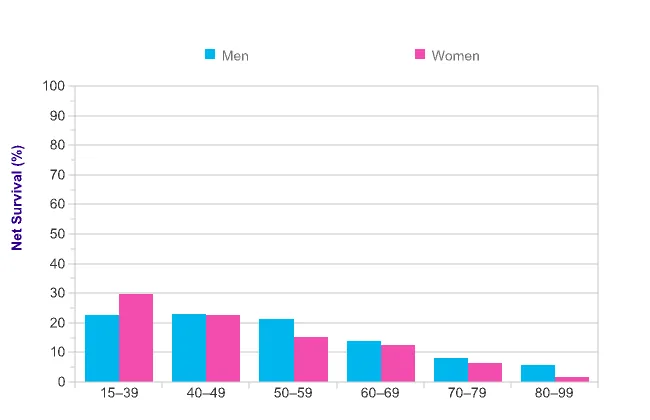
- Nach Alter
- Nach Ausbreitung
- Nach Metastasen
- Wie Sie sich selbst helfen können
Die Überlebenszahlen für Leberkrebs basieren auf Personen, die zwischen 2011 und 2017 diagnostiziert wurden. Denken Sie daran, dass Überlebensraten Schätzungen sind und auf den früheren Ergebnissen anderer beruhen – sie können Ihnen nicht sagen, was in Ihrem individuellen Fall passieren wird. Ein Grund für die niedrige Überlebensrate ist, dass viele Menschen mit Leberkrebs auch Begleiterkrankungen wie Leberzirrhose haben.
Überleben nach Ausbreitungsgrad
Wenn Leberkrebs keine Metastasen aufweist, beträgt die Fünf-Jahres-Überlebensrate 28 %. Wenn Metastasen in der Leber und in nahegelegenen Organen vorhanden sind, beträgt die Fünf-Jahres-Überlebensrate 7 %. Wenn sich der Leberkrebs auf weiter entfernte Organe oder Gewebe ausgebreitet hat, ist die Überlebensrate noch geringer. Das Überleben hängt auch stark von der angewandten Behandlung ab: Bei Leberkrebs, der chirurgisch entfernt (reseziert) werden kann, verbessert sich die Fünf-Jahres-Prognose um mehr als 50 %, insbesondere wenn die Krankheit in den frühesten Stadien entdeckt wird.
Metastasen
Das Vorhandensein und die Lage von Metastasen ist einer der stärksten prognostischen Faktoren. Leberkrebs, der lokal begrenzt bleibt, ist weitaus besser behandelbar als eine Erkrankung, die sich auf nahegelegene oder entfernte Organe ausgebreitet hat, weshalb die Früherkennung einen so großen Unterschied für das Überleben macht.
Was kann ich im Kampf gegen Leberkrebs tun?
Alkohol ist giftig für Leberzellen, daher kann sein Konsum Leberschäden mit potenziell tödlichen Folgen beschleunigen – auf Alkohol muss verzichtet werden.2 Mit dem Rauchen aufzuhören verlängert direkt die Überlebenszeit.3 Das Überleben kann auch von der Süße abhängen: Fruktose (Obst, Säfte, Süßigkeiten) ist giftig für die Leber,45 daher sollten Vitamine und Mineralstoffe aus Gemüse, Fisch und Eiern stammen.
Pilze werden seit Tausenden von Jahren wegen ihrer unübertroffenen pharmakologischen Vielfalt als Medizin verwendet. Lentinan aus dem Heilpilz Lentinus edodes ist die am gründlichsten untersuchte und dokumentierte krebshemmende Verbindung. Eine Studie7 ergab, dass Lentinan Leberkrebs unterdrückt und sogar „eine signifikante synergistische krebshemmende Wirkung“ hat, wenn es zusammen mit einer Chemotherapie eingesetzt wird. Es werden nur wasserbasierte Polysaccharidextrakte verwendet – ethanol- (alkohol-) basierte Extrakte sind billiger und schneller, extrahieren aber nicht die benötigten Verbindungen. Die Leber spielt eine zentrale Rolle bei der Entgiftung und Immunität, daher wird eine konzentrierte Multi-Extrakt-Pilz-Polysaccharid-Formel zur Unterstützung des Immunsystems und zur Verbesserung der Lebensqualität während der Behandlung untersucht.
Eine Studie ergab, dass Lentinan bei Leberkrebs eine signifikante synergistische krebshemmende Wirkung mit Chemotherapie hat. Nur wasserbasierte Extrakte liefern die aktiven Polysaccharide.
Lentinan AXT von Zenius Labs™ →Häufig gestellte Fragen
Wenn Leberkrebs keine Metastasen aufweist, beträgt die Fünf-Jahres-Überlebensrate etwa 28 %. Bei Metastasen in der Leber und nahegelegenen Organen sinkt sie auf etwa 7 % und noch weiter, sobald er sich auf entfernte Organe ausbreitet. Bei Krebserkrankungen, die chirurgisch reseziert werden können, verbessert sich die Fünf-Jahres-Prognose um mehr als 50 %.
Ein Grund ist, dass viele Menschen mit Leberkrebs auch Begleiterkrankungen wie Leberzirrhose haben. Das Überleben hängt auch stark vom Stadium bei der Diagnose und davon ab, ob der Tumor chirurgisch entfernt werden kann.
Alkohol ist giftig für Leberzellen und muss aufgegeben werden; mit dem Rauchen aufzuhören verlängert das Überleben; und Fruktose (Fruchtsäfte, Süßigkeiten) ist giftig für die Leber, daher sollten Vitamine und Mineralstoffe aus Gemüse, Fisch und Eiern stammen.
Eine Studie ergab, dass Lentinan Leberkrebs unterdrückt und neben der Chemotherapie eine signifikante synergistische krebshemmende Wirkung hat. Nur wasserbasierte Extrakte liefern die aktiven Polysaccharide. Eine konzentrierte Formel wie Lentinan AXT von Zenius Labs™ wird zur Unterstützung des Immunsystems während der Behandlung untersucht.
- Li GL et al. The anti-hepatocellular carcinoma effects of polysaccharides from Ganoderma lucidum by regulating macrophage polarization via the MAPK/NF-κB signaling pathway. Food & function. 2023. PubMed
- Yang P et al. Clinical application of a combination therapy of lentinan, multi-electrode RFA and TACE in HCC. Advances in therapy. 2008. PubMed
- Yuan Y et al. TACE-HAIC combined with targeted therapy and immunotherapy versus TACE alone for hepatocellular carcinoma with portal vein tumour thrombus: a propensity score matching study. International journal of surgery (London, England). 2023. PubMed
- Maataoui A et al. Transarterial chemoembolization alone and in combination with other therapies: a comparative study in an animal HCC model. European radiology. 2005. PubMed
- Guo N et al. Transcatheter hepatic arterial chemoembolization plus cinobufotalin injection adjuvant therapy for advanced hepatocellular carcinoma: a meta-analysis of 27 trials involving 2,079 patients. OncoTargets and therapy. 2018. PubMed
- Yang Y et al. Compound kushen injection relieves tumor-associated macrophage-mediated immunosuppression through TNFR1 and sensitizes hepatocellular carcinoma to sorafenib. Journal for immunotherapy of cancer. 2020. PubMed
- Wang C et al. Astragali radix – Curcumae rhizoma herb pair enhances Sorafenib’s efficacy by inducing ferroptosis and activates Th1 cell immune response synergistically against hepatocellular carcinoma. Phytomedicine : international journal of phytotherapy and phytopharmacology. 2025. PubMed
- Zhang QB et al. Suppression of natural killer cells by sorafenib contributes to prometastatic effects in hepatocellular carcinoma. PloS one. 2013. PubMed
- Sun Q et al. Targeting NAD(+) metabolism of hepatocellular carcinoma cells by lenvatinib promotes M2 macrophages reverse polarization, suppressing the HCC progression. Hepatology international. 2023. PubMed
- Mani SKK et al. Hepatitis B Virus-Associated Hepatocellular Carcinoma and Hepatic Cancer Stem Cells. Genes. 2018. PubMed
- Meng Y et al. Hepatitis B Virus-Mediated m6A Demethylation Increases Hepatocellular Carcinoma Stemness and Immune Escape. Molecular cancer research : MCR. 2024. PubMed
- Ortega-Prieto AM et al. Immune Evasion Strategies during Chronic Hepatitis B and C Virus Infection. Vaccines. 2017. PubMed
- Chisari FV et al. Hepatitis B virus immunopathology. Springer seminars in immunopathology. 1995. PubMed
- Meunier L et al. Chemotherapy-associated steatohepatitis. Annals of hepatology. 2020. PubMed
- Farrell GC Drugs and steatohepatitis. Seminars in liver disease. 2002. PubMed
- Huang DQ et al. Global epidemiology of NAFLD-related HCC: trends, predictions, risk factors and prevention. Nature reviews. Gastroenterology & hepatology. 2021. PubMed
- Llovet JM et al. Nonalcoholic steatohepatitis-related hepatocellular carcinoma: pathogenesis and treatment. Nature reviews. Gastroenterology & hepatology. 2023. PubMed
- Thomas SK et al. Kupffer cells prevent pancreatic ductal adenocarcinoma metastasis to the liver in mice. Nature communications. 2023. PubMed
- Pereira FE et al. Kupffer cell activation with BCG. Corynebacterium parvum or zymosan protects against acute liver injury induced by carbon tetrachloride in rats. Arquivos de gastroenterologia. 1997. PubMed
- Armbrust T et al. Functional characterization of two different Kupffer cell populations of normal rat liver. Journal of hepatology. 1996. PubMed
- Youssef J et al. Activated Kupffer cells attenuate the liver response to the peroxisome proliferator perfluorooctanoic acid. Molecular and cellular biochemistry. 1997. PubMed
- Lau HC et al. Gut microbiome in metabolic dysfunction-associated steatotic liver disease and associated hepatocellular carcinoma. Nature reviews. Gastroenterology & hepatology. 2025. PubMed
- Yu LX et al. The gut microbiome and liver cancer: mechanisms and clinical translation. Nature reviews. Gastroenterology & hepatology. 2017. PubMed
- Jiang JW et al. Gut microbial dysbiosis associates hepatocellular carcinoma via the gut-liver axis. Hepatobiliary & pancreatic diseases international : HBPD INT. 2019. PubMed
- Ahmad MF et al. Ganoderma lucidum: Novel Insight into Hepatoprotective Potential with Mechanisms of Action. Nutrients. 2023. PubMed
- Bahmani M et al. Silybum marianum: Beyond Hepatoprotection. Journal of evidence-based complementary & alternative medicine. 2015. PubMed
- Lu X et al. Pretransplant immunotherapy increases acute rejection yet improves survival outcome of HCC patients with MVI post-liver transplantation. Cancer immunology, immunotherapy : CII. 2024. PubMed
- Rezaee-Zavareh MS et al. Impact of pre-transplant immune checkpoint inhibitor use on post-transplant outcomes in HCC: A systematic review and individual patient data meta-analysis. Journal of hepatology. 2025. PubMed
- Ersan V et al. The Timing of Liver Transplantation Following Downstaging: Wait of Not to Wait?. Journal of gastrointestinal cancer. 2020. PubMed
- Hong G et al. Safety and Therapeutic Outcomes of Adjuvant Immunotherapy With Autologous Cytokine-induced Killer Cells for Patients With Hepatocellular Carcinoma Beyond Milan Criteria After Liver Transplantation. Transplantation. 2025. PubMed
- Leuchte K et al. Microwave ablation enhances tumor-specific immune response in patients with hepatocellular carcinoma. Cancer immunology, immunotherapy : CII. 2021. PubMed
- Lei Y et al. COX-2/PGE(2) axis blockade with celecoxib enhances anti-PD-1 efficacy by activating natural killer cells for residual hepatocellular carcinoma after radiofrequency ablation. Journal of experimental & clinical cancer research : CR. 2025. PubMed
- Qian L et al. Potent induction of antitumor immunity by combining cryo-thermal ablation with immune checkpoint inhibitors in hepatocellular carcinoma. Liver international : official journal of the International Association for the Study of the Liver. 2024. PubMed
- Xu X et al. Activation of Anti-tumor Immune Response by Ablation of HCC with Nanosecond Pulsed Electric Field. Journal of clinical and translational hepatology. 2018. PubMed
- Li J et al. Astaxanthin Inhibits Proliferation and Induces Apoptosis of Human Hepatocellular Carcinoma Cells via Inhibition of Nf-Κb P65 and Wnt/Β-Catenin in Vitro. Marine drugs. 2015. PubMed
- Laderian A et al. Hepatoprotective effect of astaxanthin against cholestasis liver fibrosis induced by bile duct ligation in adult Wistar rats. Journal of biochemical and molecular toxicology. 2024. PubMed
- Takada T et al. [Case of hepatocellular carcinoma with a marked reduction in the tumor size induced by PSK administration alone]. Gan to kagaku ryoho. Cancer & chemotherapy. 1983. PubMed
- Hara Y et al. [Disappearance of lung metastases from hepatocellular carcinoma following PSK administration]. Rinsho hoshasen. Clinical radiography. 1988. PubMed
- You J et al. Lentinan induces apoptosis of mouse hepatocellular carcinoma cells through the EGR1/PTEN/AKT signaling axis. Oncology reports. 2023. PubMed
- Wang Z et al. Apaf1 nanoLuc biosensors identified lentinan as a potent synergizer of cisplatin in targeting hepatocellular carcinoma cells. Biochemical and biophysical research communications. 2021. PubMed
- Wang Y et al. Effects of tumor-specific antigen induced by lentinan on murine H22 hepatocellular carcinoma immunoprophylaxis. European review for medical and pharmacological sciences. 2015. PubMed
- Isoda N et al. Clinical efficacy of superfine dispersed lentinan (beta-1,3-glucan) in patients with hepatocellular carcinoma. Hepato-gastroenterology. 2009. PubMed
- Wang H et al. Efficacy of biological response modifier lentinan with chemotherapy for advanced cancer: a meta-analysis. Cancer medicine. 2017. PubMed
- Oba K et al. Efficacy of adjuvant immunochemotherapy with polysaccharide K for patients with curative resections of gastric cancer. Cancer immunology, immunotherapy : CII. 2007. PubMed
- Cheng SC et al. mTOR- and HIF-1α-mediated aerobic glycolysis as metabolic basis for trained immunity. Science (New York, N.Y.). 2014. PubMed
- Kidd P Astaxanthin, cell membrane nutrient with diverse clinical benefits and anti-aging potential. Alternative medicine review : a journal of clinical therapeutic. 2011. PubMed
- Wang Y et al. Systematic review and meta-analysis on the efficacy and safety of Injectable Lentinan combined with chemotherapy in the treatment of gastric cancer. Phytomedicine : international journal of phytotherapy and phytopharmacology. 2024. PubMed