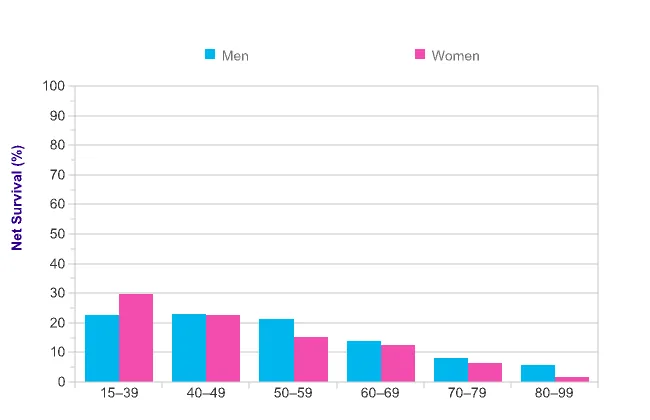
- Par âge
- Par propagation
- Par métastases
- Comment vous aider
Les chiffres de survie du cancer du foie sont basés sur les personnes diagnostiquées entre 2011 et 2017. N'oubliez pas que les taux de survie sont approximatifs et basés sur les résultats passés d'autres personnes — ils ne peuvent pas vous dire ce qui se passera dans votre cas individuel. Une des raisons de la faible survie est que de nombreuses personnes atteintes d'un cancer du foie présentent également des comorbidités telles que la cirrhose du foie.
Survie selon l'étendue de la propagation
Si le cancer du foie n'a pas de métastases, la survie à cinq ans est de 28 %. S'il y a des métastases dans le foie et les organes voisins, la survie à cinq ans est de 7 %. Lorsque le cancer du foie s'est propagé à des organes ou des tissus plus éloignés, la survie est encore plus faible. La survie dépend aussi fortement du traitement appliqué : pour un cancer du foie qui peut être retiré chirurgicalement (réséqué), le pronostic à cinq ans s'améliore de plus de 50 %, surtout lorsque la maladie est découverte aux stades les plus précoces.
Métastases
La présence et la localisation des métastases sont l'un des facteurs les plus importants pour le pronostic. Un cancer du foie qui reste localisé est beaucoup plus facile à traiter qu'une maladie qui s'est propagée aux organes voisins ou distants, c'est pourquoi la détection précoce fait une si grande différence pour la survie.
Que puis-je faire dans la lutte contre le cancer du foie ?
L'alcool est toxique pour les cellules du foie, sa consommation peut donc accélérer les lésions hépatiques avec des conséquences potentiellement mortelles — il faudra renoncer à l'alcool.2 L'arrêt du tabac allonge directement la durée de survie.3 La survie peut également dépendre du sucre : le fructose (fruits, jus, sucreries) est toxique pour le foie,45 les vitamines et les minéraux devraient donc provenir des légumes, du poisson et des œufs.
Les champignons sont utilisés comme médicaments depuis des milliers d'années pour leur diversité pharmacologique inégalée. Le Lentinan, issu du champignon médicinal Lentinus edodes, est le composé anticancéreux le plus étudié et documenté. Une étude7 a révélé que le lentinan supprime le cancer du foie et a même « un effet anticancéreux synergique significatif » lorsqu'il est utilisé en association avec la chimiothérapie. Seuls les extraits de polysaccharides à base d'eau sont utilisés — les extraits à base d'éthanol (alcool) sont moins chers et plus rapides mais n'extraient pas les composés dont nous avons besoin. Le foie joue un rôle central dans la détoxification et l'immunité, c'est pourquoi une formule concentrée de polysaccharides de champignons multi-extraits est étudiée pour soutenir le système immunitaire et améliorer la qualité de vie pendant le traitement.
Une étude a révélé que le lentinan a un effet anticancéreux synergique significatif avec la chimiothérapie dans le cancer du foie. Seuls les extraits à base d'eau fournissent les polysaccharides actifs.
Lentinan AXT par Zenius Labs™ →Foire aux questions
Si le cancer du foie n'a pas de métastases, la survie à cinq ans est d'environ 28 %. Avec des métastases au foie et aux organes voisins, elle tombe à environ 7 %, et encore plus bas une fois qu'il se propage à des organes distants. Pour les cancers qui peuvent être réséqués chirurgicalement, le pronostic à cinq ans s'améliore de plus de 50 %.
Une des raisons est que de nombreuses personnes atteintes d'un cancer du foie présentent également des comorbidités telles que la cirrhose du foie. La survie dépend aussi fortement du stade au moment du diagnostic et de la possibilité de retirer la tumeur chirurgicalement.
L'alcool est toxique pour les cellules du foie et doit être abandonné ; l'arrêt du tabac allonge la survie ; et le fructose (jus de fruits, sucreries) est toxique pour le foie, les vitamines et les minéraux devraient donc provenir des légumes, du poisson et des œufs.
Une étude a révélé que le lentinan supprime le cancer du foie et a un effet anticancéreux synergique significatif en association avec la chimiothérapie. Seuls les extraits à base d'eau fournissent les polysaccharides actifs. Une formule concentrée telle que Lentinan AXT de Zenius Labs™ est étudiée pour le soutien immunitaire pendant le traitement.
- Li GL et al. The anti-hepatocellular carcinoma effects of polysaccharides from Ganoderma lucidum by regulating macrophage polarization via the MAPK/NF-κB signaling pathway. Food & function. 2023. PubMed
- Yang P et al. Clinical application of a combination therapy of lentinan, multi-electrode RFA and TACE in HCC. Advances in therapy. 2008. PubMed
- Yuan Y et al. TACE-HAIC combined with targeted therapy and immunotherapy versus TACE alone for hepatocellular carcinoma with portal vein tumour thrombus: a propensity score matching study. International journal of surgery (London, England). 2023. PubMed
- Maataoui A et al. Transarterial chemoembolization alone and in combination with other therapies: a comparative study in an animal HCC model. European radiology. 2005. PubMed
- Guo N et al. Transcatheter hepatic arterial chemoembolization plus cinobufotalin injection adjuvant therapy for advanced hepatocellular carcinoma: a meta-analysis of 27 trials involving 2,079 patients. OncoTargets and therapy. 2018. PubMed
- Yang Y et al. Compound kushen injection relieves tumor-associated macrophage-mediated immunosuppression through TNFR1 and sensitizes hepatocellular carcinoma to sorafenib. Journal for immunotherapy of cancer. 2020. PubMed
- Wang C et al. Astragali radix – Curcumae rhizoma herb pair enhances Sorafenib’s efficacy by inducing ferroptosis and activates Th1 cell immune response synergistically against hepatocellular carcinoma. Phytomedicine : international journal of phytotherapy and phytopharmacology. 2025. PubMed
- Zhang QB et al. Suppression of natural killer cells by sorafenib contributes to prometastatic effects in hepatocellular carcinoma. PloS one. 2013. PubMed
- Sun Q et al. Targeting NAD(+) metabolism of hepatocellular carcinoma cells by lenvatinib promotes M2 macrophages reverse polarization, suppressing the HCC progression. Hepatology international. 2023. PubMed
- Mani SKK et al. Hepatitis B Virus-Associated Hepatocellular Carcinoma and Hepatic Cancer Stem Cells. Genes. 2018. PubMed
- Meng Y et al. Hepatitis B Virus-Mediated m6A Demethylation Increases Hepatocellular Carcinoma Stemness and Immune Escape. Molecular cancer research : MCR. 2024. PubMed
- Ortega-Prieto AM et al. Immune Evasion Strategies during Chronic Hepatitis B and C Virus Infection. Vaccines. 2017. PubMed
- Chisari FV et al. Hepatitis B virus immunopathology. Springer seminars in immunopathology. 1995. PubMed
- Meunier L et al. Chemotherapy-associated steatohepatitis. Annals of hepatology. 2020. PubMed
- Farrell GC Drugs and steatohepatitis. Seminars in liver disease. 2002. PubMed
- Huang DQ et al. Global epidemiology of NAFLD-related HCC: trends, predictions, risk factors and prevention. Nature reviews. Gastroenterology & hepatology. 2021. PubMed
- Llovet JM et al. Nonalcoholic steatohepatitis-related hepatocellular carcinoma: pathogenesis and treatment. Nature reviews. Gastroenterology & hepatology. 2023. PubMed
- Thomas SK et al. Kupffer cells prevent pancreatic ductal adenocarcinoma metastasis to the liver in mice. Nature communications. 2023. PubMed
- Pereira FE et al. Kupffer cell activation with BCG. Corynebacterium parvum or zymosan protects against acute liver injury induced by carbon tetrachloride in rats. Arquivos de gastroenterologia. 1997. PubMed
- Armbrust T et al. Functional characterization of two different Kupffer cell populations of normal rat liver. Journal of hepatology. 1996. PubMed
- Youssef J et al. Activated Kupffer cells attenuate the liver response to the peroxisome proliferator perfluorooctanoic acid. Molecular and cellular biochemistry. 1997. PubMed
- Lau HC et al. Gut microbiome in metabolic dysfunction-associated steatotic liver disease and associated hepatocellular carcinoma. Nature reviews. Gastroenterology & hepatology. 2025. PubMed
- Yu LX et al. The gut microbiome and liver cancer: mechanisms and clinical translation. Nature reviews. Gastroenterology & hepatology. 2017. PubMed
- Jiang JW et al. Gut microbial dysbiosis associates hepatocellular carcinoma via the gut-liver axis. Hepatobiliary & pancreatic diseases international : HBPD INT. 2019. PubMed
- Ahmad MF et al. Ganoderma lucidum: Novel Insight into Hepatoprotective Potential with Mechanisms of Action. Nutrients. 2023. PubMed
- Bahmani M et al. Silybum marianum: Beyond Hepatoprotection. Journal of evidence-based complementary & alternative medicine. 2015. PubMed
- Lu X et al. Pretransplant immunotherapy increases acute rejection yet improves survival outcome of HCC patients with MVI post-liver transplantation. Cancer immunology, immunotherapy : CII. 2024. PubMed
- Rezaee-Zavareh MS et al. Impact of pre-transplant immune checkpoint inhibitor use on post-transplant outcomes in HCC: A systematic review and individual patient data meta-analysis. Journal of hepatology. 2025. PubMed
- Ersan V et al. The Timing of Liver Transplantation Following Downstaging: Wait of Not to Wait?. Journal of gastrointestinal cancer. 2020. PubMed
- Hong G et al. Safety and Therapeutic Outcomes of Adjuvant Immunotherapy With Autologous Cytokine-induced Killer Cells for Patients With Hepatocellular Carcinoma Beyond Milan Criteria After Liver Transplantation. Transplantation. 2025. PubMed
- Leuchte K et al. Microwave ablation enhances tumor-specific immune response in patients with hepatocellular carcinoma. Cancer immunology, immunotherapy : CII. 2021. PubMed
- Lei Y et al. COX-2/PGE(2) axis blockade with celecoxib enhances anti-PD-1 efficacy by activating natural killer cells for residual hepatocellular carcinoma after radiofrequency ablation. Journal of experimental & clinical cancer research : CR. 2025. PubMed
- Qian L et al. Potent induction of antitumor immunity by combining cryo-thermal ablation with immune checkpoint inhibitors in hepatocellular carcinoma. Liver international : official journal of the International Association for the Study of the Liver. 2024. PubMed
- Xu X et al. Activation of Anti-tumor Immune Response by Ablation of HCC with Nanosecond Pulsed Electric Field. Journal of clinical and translational hepatology. 2018. PubMed
- Li J et al. Astaxanthin Inhibits Proliferation and Induces Apoptosis of Human Hepatocellular Carcinoma Cells via Inhibition of Nf-Κb P65 and Wnt/Β-Catenin in Vitro. Marine drugs. 2015. PubMed
- Laderian A et al. Hepatoprotective effect of astaxanthin against cholestasis liver fibrosis induced by bile duct ligation in adult Wistar rats. Journal of biochemical and molecular toxicology. 2024. PubMed
- Takada T et al. [Case of hepatocellular carcinoma with a marked reduction in the tumor size induced by PSK administration alone]. Gan to kagaku ryoho. Cancer & chemotherapy. 1983. PubMed
- Hara Y et al. [Disappearance of lung metastases from hepatocellular carcinoma following PSK administration]. Rinsho hoshasen. Clinical radiography. 1988. PubMed
- You J et al. Lentinan induces apoptosis of mouse hepatocellular carcinoma cells through the EGR1/PTEN/AKT signaling axis. Oncology reports. 2023. PubMed
- Wang Z et al. Apaf1 nanoLuc biosensors identified lentinan as a potent synergizer of cisplatin in targeting hepatocellular carcinoma cells. Biochemical and biophysical research communications. 2021. PubMed
- Wang Y et al. Effects of tumor-specific antigen induced by lentinan on murine H22 hepatocellular carcinoma immunoprophylaxis. European review for medical and pharmacological sciences. 2015. PubMed
- Isoda N et al. Clinical efficacy of superfine dispersed lentinan (beta-1,3-glucan) in patients with hepatocellular carcinoma. Hepato-gastroenterology. 2009. PubMed
- Wang H et al. Efficacy of biological response modifier lentinan with chemotherapy for advanced cancer: a meta-analysis. Cancer medicine. 2017. PubMed
- Oba K et al. Efficacy of adjuvant immunochemotherapy with polysaccharide K for patients with curative resections of gastric cancer. Cancer immunology, immunotherapy : CII. 2007. PubMed
- Cheng SC et al. mTOR- and HIF-1α-mediated aerobic glycolysis as metabolic basis for trained immunity. Science (New York, N.Y.). 2014. PubMed
- Kidd P Astaxanthin, cell membrane nutrient with diverse clinical benefits and anti-aging potential. Alternative medicine review : a journal of clinical therapeutic. 2011. PubMed
- Wang Y et al. Systematic review and meta-analysis on the efficacy and safety of Injectable Lentinan combined with chemotherapy in the treatment of gastric cancer. Phytomedicine : international journal of phytotherapy and phytopharmacology. 2024. PubMed