¿Qué es el linfoma difuso de células B grandes?
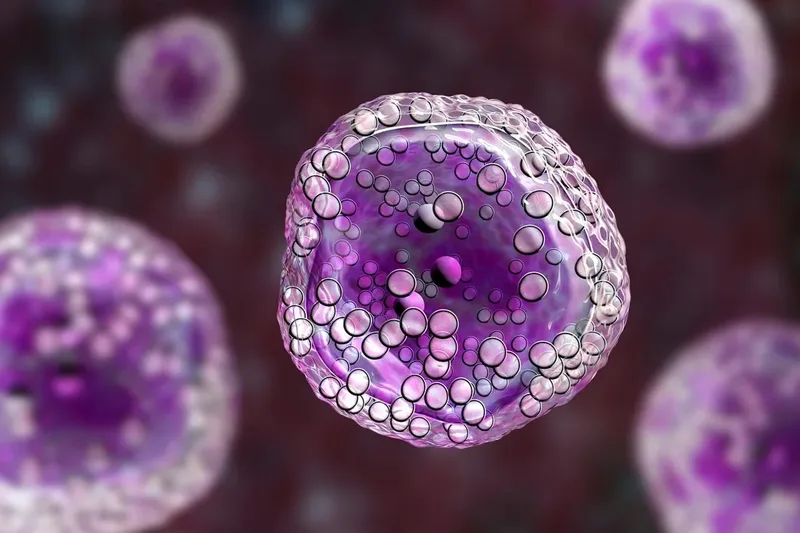
El linfoma difuso de células B grandes es un linfoma no hodgkiniano agresivo que se desarrolla a partir de las células B del sistema linfático. Bajo el microscopio, se observan linfocitos malignos grandes. El linfoma difuso de células B grandes es el tipo más común de linfoma no hodgkiniano.
Síntomas del linfoma difuso de células B grandes
A menudo, el primer síntoma es una hinchazón indolora en el cuello, la axila o la ingle, causada por ganglios linfáticos agrandados. Estos bultos pueden crecer con bastante rapidez, a menudo en unas pocas semanas. A veces, otras partes del cuerpo se ven afectadas. La enfermedad puede ocurrir fuera de los ganglios linfáticos y puede afectar el estómago o los intestinos, causando malestar o dolor abdominal, diarrea o sangrado. Este linfoma también puede aparecer en muchas otras áreas, incluidas las glándulas salivales, los senos paranasales, el hígado, los pulmones, los testículos, la piel, el cerebro o los ojos, con síntomas que dependen directamente de la ubicación.
Causas del linfoma difuso de células B grandes
Aunque no se conocen las causas exactas, no es una enfermedad hereditaria. Las personas cuyo sistema inmunitario está debilitado pueden tener más probabilidades de desarrollarlo — esto puede incluir a personas tratadas previamente por otras formas de cáncer o personas con trastornos autoinmunitarios.
Tratamiento del linfoma difuso de células B grandes
El linfoma difuso de células B grandes es una enfermedad de desarrollo rápido, por lo que debe tratarse con urgencia. El tratamiento actual es la terapia dirigida y la quimioterapia estándar, que generalmente se continúan durante unos 4 meses. La quimioterapia utiliza medicamentos para destruir el cáncer y puede tener varios efectos secundarios. Otros métodos de tratamiento incluyen la radiación y el trasplante de células madre.
Suplementos para el cáncer
Es fundamental organizar su dieta y los otros factores (caminatas largas, respiración, abandono de sustancias cancerígenas, etc.) que solo usted puede controlar. Entonces el tratamiento contra el cáncer (como la quimioterapia) será aún más eficaz. Con suplementos naturales (como Lentinan) puede ayudar al sistema inmunitario a combatir las células cancerosas. Los compuestos activos extraídos de hongos medicinales mejoran la calidad de vida, apoyan la lucha contra el cáncer e incluso pueden aumentar la eficacia de los medicamentos. Estos compuestos, ampliamente utilizados en Oriente (en Japón), son potentes inmunomoduladores que incitan al sistema inmunitario a detectar y actuar sobre las células cancerosas.
Se estudian los polisacáridos de hongos concentrados por su capacidad para activar las células NK y los macrófagos y para apoyar la calidad de vida junto con la quimioterapia.
Lentinan AXT de Zenius Labs™ →Preguntas frecuentes
Es un linfoma no hodgkiniano agresivo que se desarrolla a partir de las células B del sistema linfático, con grandes linfocitos malignos visibles bajo el microscopio. Es el tipo más común de linfoma no hodgkiniano.
Es una enfermedad de desarrollo rápido — los bultos pueden crecer en unas pocas semanas — por lo que debe tratarse con urgencia.
No. No se conocen las causas exactas, pero no es hereditario. Las personas con sistemas inmunitarios debilitados — incluidas aquellas tratadas previamente por otros cánceres o con trastornos autoinmunitarios — pueden tener más probabilidades de desarrollarlo.
El tratamiento actual es la terapia dirigida y la quimioterapia estándar, que generalmente se continúan durante unos 4 meses. Otras opciones incluyen la radiación y el trasplante de células madre.
Sí. Se estudian los extractos concentrados de polisacáridos de hongos por su papel en la activación de las células NK y los macrófagos y en el apoyo a la calidad de vida junto con la quimioterapia. Una fórmula multiextracto concentrada como Lentinan AXT de Zenius Labs™ es preferible a los polvos simples.
- CAR T-cell therapy in large B cell lymphoma. PubMed
- CAR T cells vs bispecific antibody as third- or later-line large B-cell lymph…. PubMed
- Recent advances in CAR T-cell toxicity: Mechanisms, manifestations and manage…. PubMed
- Tani M et al. In vitro generation of activated natural killer cells and cytotoxic macrophages with lentinan. European journal of clinical pharmacology. 1992. PubMed
- Hamano K et al. The preoperative administration of lentinan ameliorated the impairment of natural killer activity after cardiopulmonary bypass. International journal of immunopharmacology. 1999. PubMed
- Mattiola I et al. The macrophage tetraspan MS4A4A enhances dectin-1-dependent NK cell-mediated resistance to metastasis. Nature immunology. 2019. PubMed
- Zhou X et al. The role of complement in the mechanism of action of rituximab for B-cell lymphoma: implications for therapy. The oncologist. 2008. PubMed
- Li B et al. Yeast beta-glucan amplifies phagocyte killing of iC3b-opsonized tumor cells via complement receptor 3-Syk-phosphatidylinositol 3-kinase pathway. Journal of immunology (Baltimore, Md. : 1950). 2006. PubMed
- Xia Y et al. The beta-glucan-binding lectin site of mouse CR3 (CD11b/CD18) and its function in generating a primed state of the receptor that mediates cytotoxic activation in response to iC3b-opsonized target cells. Journal of immunology (Baltimore, Md. : 1950). 1999. PubMed
- Lu H et al. TLR2 agonist PSK activates human NK cells and enhances the antitumor effect of HER2-targeted monoclonal antibody therapy. Clinical cancer research : an official journal of the American Association for Cancer Research. 2011. PubMed
- Ooshiro M et al. [Ten cases of advanced gastro-intestinal cancer that required preoperative dosage of PSK]. Gan to kagaku ryoho. Cancer & chemotherapy. 2009. PubMed
- Maehara Y et al. Postoperative PSK and OK-432 immunochemotherapy for patients with gastric cancer. Cancer chemotherapy and pharmacology. 1993. PubMed
- Adachi Y et al. Potentiation of Antitumor Activity by Antibody Drugs and Mushroom-Derived β-Glucans in Natural Killer Cell-Mediated Tumoricidal Activities against Non-Hodgkin’s B-Cell Lymphoma. International journal of medicinal mushrooms. 2023. PubMed
- Sam J et al. Preclinical advances in glofitamab combinations: a new frontier for non-Hodgkin lymphoma. Blood. 2025. PubMed
- Ansell SM et al. PD-1 blockade with nivolumab in relapsed or refractory Hodgkin’s lymphoma. The New England journal of medicine. 2015. PubMed
- Azoulay T et al. Compromised activity of natural killer cells in diffuse large b-cell lymphoma is related to lymphoma-induced modification of their surface receptor expression. Cancer immunology, immunotherapy : CII. 2023. PubMed
- Sato A et al. [Pathogenesis and novel therapy for EBV-related B-cell lymphoma]. [Rinsho ketsueki] The Japanese journal of clinical hematology. 2016. PubMed
- Chen J et al. Epstein-Barr virus: biology, pathogenesis and therapy of lymphomas. Discover oncology. 2025. PubMed
- Liquidano-Perez E et al. Case Report: Hydroa vacciniforme-like lymphoproliferative disorder, an EBV-associated disease, successfully treated with hematopoietic stem cell transplantation. Frontiers in immunology. 2025. PubMed
- Song JY et al. Low T-cell proportion in the tumor microenvironment is associated with immune escape and poor survival in diffuse large B-cell lymphoma. Haematologica. 2023. PubMed
- Greenbaum AM et al. Diffuse large B-cell lymphoma (DLBCL) is infiltrated with activated CD8(+) T-cells despite immune checkpoint signaling. Blood research. 2022. PubMed
- Liu WR et al. Signaling pathways and immune evasion mechanisms in classical Hodgkin lymphoma. Blood. 2017. PubMed
- Wang D et al. Dectin-1 stimulates IL-33 expression in dendritic cells via upregulation of IRF4. Laboratory investigation; a journal of technical methods and pathology. 2018. PubMed
- Engel AL et al. Protein-bound polysaccharide activates dendritic cells and enhances OVA-specific T cell response as vaccine adjuvant. Immunobiology. 2013. PubMed
- Wang Y et al. Systematic review and meta-analysis on the efficacy and safety of Injectable Lentinan combined with chemotherapy in the treatment of gastric cancer. Phytomedicine : international journal of phytotherapy and phytopharmacology. 2024. PubMed
- Oba K et al. Individual patient based meta-analysis of lentinan for unresectable/recurrent gastric cancer. Anticancer research. 2009. PubMed
- Wang Y et al. Investigation on the efficiency of lentinan for injection combining cisplatin on treating malignant pleural effusion based on systematic review and meta-analysis. Medicine. 2024. PubMed
- Park JS et al. Astaxanthin decreased oxidative stress and inflammation and enhanced immune response in humans. Nutrition & metabolism. 2010. PubMed
- Cheng J et al. The Promising Effects of Astaxanthin on Lung Diseases. Advances in nutrition (Bethesda, Md.). 2021. PubMed
- Lee J et al. Anti-Oxidant and Anti-Inflammatory Effects of Astaxanthin on Gastrointestinal Diseases. International journal of molecular sciences. 2022. PubMed
- Cheng SC et al. mTOR- and HIF-1α-mediated aerobic glycolysis as metabolic basis for trained immunity. Science (New York, N.Y.). 2014. PubMed
- van der Meer JW et al. Trained immunity: A smart way to enhance innate immune defence. Molecular immunology. 2015. PubMed
- Vuscan P et al. Potent induction of trained immunity by Saccharomyces cerevisiae β-glucans. Frontiers in immunology. 2024. PubMed
- Zou X et al. Radioprotective effect of edible and medicinal mushrooms against ionizing radiation: Components, potential mechanisms, and applications. Food research international (Ottawa, Ont.). 2025. PubMed
- Liu F et al. The mechanisms for the radioprotective effect of beta-d-glucan on high linear-energy-transfer carbon ion irradiated mice. International journal of biological macromolecules. 2019. PubMed
- Christophersen OA Radiation protection following nuclear power accidents: a survey of putative mechanisms involved in the radioprotective actions of taurine during and after radiation exposure. Microbial ecology in health and disease. 2012. PubMed
- Fang J et al. Structure of a β-glucan from Grifola frondosa and its antitumor effect by activating Dectin-1/Syk/NF-κB signaling. Glycoconjugate journal. 2012. PubMed
- Zhang M et al. β-Glucan from Saccharomyces cerevisiae induces SBD-1 production in ovine ruminal epithelial cells via the Dectin-1-Syk-NF-κB signaling pathway. Cellular signalling. 2019. PubMed
- Gringhuis SI et al. Dectin-1 directs T helper cell differentiation by controlling noncanonical NF-kappaB activation through Raf-1 and Syk. Nature immunology. 2009. PubMed