Wat is diffuus grootcellig B-cellymfoom?
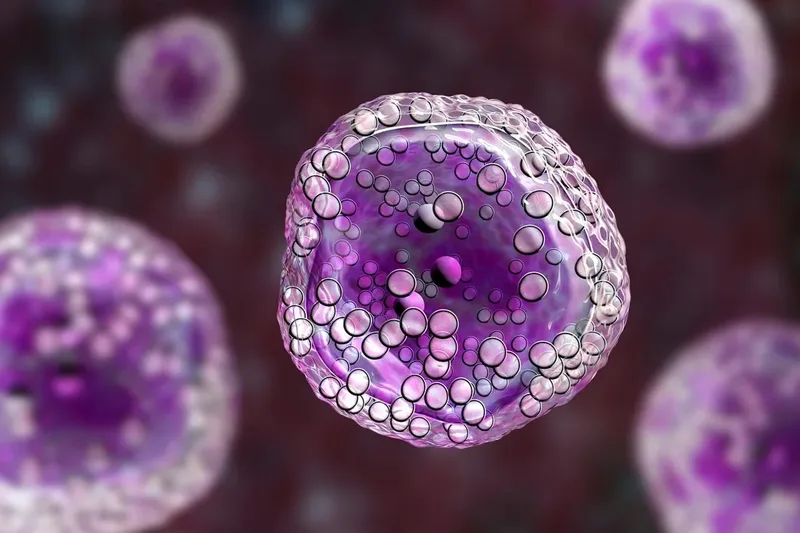
Diffuus grootcellig B-cellymfoom is een agressief non-hodgkinlymfoom dat zich ontwikkelt uit de B-cellen van het lymfestelsel. Onder de microscoop zijn grote kwaadaardige lymfocyten zichtbaar. Diffuus grootcellig B-cellymfoom is het meest voorkomende type non-hodgkinlymfoom.
Symptomen van diffuus grootcellig B-cellymfoom
Vaak is het eerste symptoom een pijnloze zwelling in de nek, oksel of lies, veroorzaakt door vergrote lymfeklieren. Deze knobbels kunnen vrij snel groeien, vaak binnen enkele weken. Soms zijn andere delen van het lichaam aangetast. De ziekte kan buiten de lymfeklieren voorkomen en de maag of darmen aantasten, wat buikklachten of -pijn, diarree of bloedingen veroorzaakt. Dit lymfoom kan ook op veel andere plaatsen verschijnen, waaronder de speekselklieren, sinussen, lever, longen, testikels, huid, hersenen of ogen, waarbij de symptomen rechtstreeks afhangen van de locatie.
Oorzaken van diffuus grootcellig B-cellymfoom
Hoewel de precieze oorzaken niet bekend zijn, is het geen erfelijke ziekte. Mensen met een verzwakt immuunsysteem hebben mogelijk een grotere kans om het te ontwikkelen — dit kunnen mensen zijn die eerder zijn behandeld voor andere vormen van kanker, of mensen met auto-immuunziekten.
Behandeling van diffuus grootcellig B-cellymfoom
Diffuus grootcellig B-cellymfoom is een snel ontwikkelende ziekte, dus het moet dringend worden behandeld. De huidige behandeling is doelgerichte therapie en standaardchemotherapie, die meestal ongeveer 4 maanden wordt voortgezet. Chemotherapie gebruikt medicijnen om de kanker te vernietigen en kan verschillende bijwerkingen hebben. Andere behandelmethoden zijn bestraling en stamceltransplantatie.
Supplementen bij kanker
Het is essentieel om uw dieet en de andere factoren (lange wandelingen, ademhaling, het opgeven van kankerverwekkende stoffen, enzovoort) die alleen u kunt beheren, op orde te brengen. Dan zal de behandeling van kanker (zoals chemotherapie) nog effectiever zijn. Met natuurlijke supplementen (zoals Lentinan) kunt u het immuunsysteem helpen kankercellen te bestrijden. Actieve verbindingen die uit medicinale paddenstoelen worden geëxtraheerd, verbeteren de levenskwaliteit, ondersteunen de strijd tegen kanker en kunnen zelfs de effectiviteit van medicijnen verhogen. Deze verbindingen, die veel worden gebruikt in het Oosten (in Japan), zijn krachtige immunomodulatoren die het immuunsysteem aanzetten om kankercellen te detecteren en hierop te reageren.
Geconcentreerde polysachariden uit paddenstoelen worden bestudeerd voor het activeren van NK-cellen en macrofagen en het ondersteunen van de levenskwaliteit naast chemotherapie.
Lentinan AXT van Zenius Labs™ →Veelgestelde vragen
Het is een agressief non-hodgkinlymfoom dat zich ontwikkelt uit de B-cellen van het lymfestelsel, waarbij grote kwaadaardige lymfocyten zichtbaar zijn onder de microscoop. Het is het meest voorkomende type non-hodgkinlymfoom.
Het is een snel ontwikkelende ziekte — knobbels kunnen binnen enkele weken groeien — dus het moet dringend worden behandeld.
Nee. De precieze oorzaken zijn niet bekend, maar het is niet erfelijk. Mensen met een verzwakt immuunsysteem — inclusief degenen die eerder zijn behandeld voor andere kankers of met auto-immuunziekten — hebben mogelijk een grotere kans om het te ontwikkelen.
De huidige behandeling is doelgerichte therapie en standaardchemotherapie, die meestal ongeveer 4 maanden wordt voortgezet. Andere opties zijn bestraling en stamceltransplantatie.
Ja. Geconcentreerde extracten van paddenstoelpolysachariden worden bestudeerd voor hun rol bij het activeren van NK-cellen en macrofagen en het ondersteunen van de levenskwaliteit naast chemotherapie. Een geconcentreerde multi-extractformule zoals Lentinan AXT van Zenius Labs™ heeft de voorkeur boven eenvoudige poeders.
- CAR T-cell therapy in large B cell lymphoma. PubMed
- CAR T cells vs bispecific antibody as third- or later-line large B-cell lymph…. PubMed
- Recent advances in CAR T-cell toxicity: Mechanisms, manifestations and manage…. PubMed
- Tani M et al. In vitro generation of activated natural killer cells and cytotoxic macrophages with lentinan. European journal of clinical pharmacology. 1992. PubMed
- Hamano K et al. The preoperative administration of lentinan ameliorated the impairment of natural killer activity after cardiopulmonary bypass. International journal of immunopharmacology. 1999. PubMed
- Mattiola I et al. The macrophage tetraspan MS4A4A enhances dectin-1-dependent NK cell-mediated resistance to metastasis. Nature immunology. 2019. PubMed
- Zhou X et al. The role of complement in the mechanism of action of rituximab for B-cell lymphoma: implications for therapy. The oncologist. 2008. PubMed
- Li B et al. Yeast beta-glucan amplifies phagocyte killing of iC3b-opsonized tumor cells via complement receptor 3-Syk-phosphatidylinositol 3-kinase pathway. Journal of immunology (Baltimore, Md. : 1950). 2006. PubMed
- Xia Y et al. The beta-glucan-binding lectin site of mouse CR3 (CD11b/CD18) and its function in generating a primed state of the receptor that mediates cytotoxic activation in response to iC3b-opsonized target cells. Journal of immunology (Baltimore, Md. : 1950). 1999. PubMed
- Lu H et al. TLR2 agonist PSK activates human NK cells and enhances the antitumor effect of HER2-targeted monoclonal antibody therapy. Clinical cancer research : an official journal of the American Association for Cancer Research. 2011. PubMed
- Ooshiro M et al. [Ten cases of advanced gastro-intestinal cancer that required preoperative dosage of PSK]. Gan to kagaku ryoho. Cancer & chemotherapy. 2009. PubMed
- Maehara Y et al. Postoperative PSK and OK-432 immunochemotherapy for patients with gastric cancer. Cancer chemotherapy and pharmacology. 1993. PubMed
- Adachi Y et al. Potentiation of Antitumor Activity by Antibody Drugs and Mushroom-Derived β-Glucans in Natural Killer Cell-Mediated Tumoricidal Activities against Non-Hodgkin’s B-Cell Lymphoma. International journal of medicinal mushrooms. 2023. PubMed
- Sam J et al. Preclinical advances in glofitamab combinations: a new frontier for non-Hodgkin lymphoma. Blood. 2025. PubMed
- Ansell SM et al. PD-1 blockade with nivolumab in relapsed or refractory Hodgkin’s lymphoma. The New England journal of medicine. 2015. PubMed
- Azoulay T et al. Compromised activity of natural killer cells in diffuse large b-cell lymphoma is related to lymphoma-induced modification of their surface receptor expression. Cancer immunology, immunotherapy : CII. 2023. PubMed
- Sato A et al. [Pathogenesis and novel therapy for EBV-related B-cell lymphoma]. [Rinsho ketsueki] The Japanese journal of clinical hematology. 2016. PubMed
- Chen J et al. Epstein-Barr virus: biology, pathogenesis and therapy of lymphomas. Discover oncology. 2025. PubMed
- Liquidano-Perez E et al. Case Report: Hydroa vacciniforme-like lymphoproliferative disorder, an EBV-associated disease, successfully treated with hematopoietic stem cell transplantation. Frontiers in immunology. 2025. PubMed
- Song JY et al. Low T-cell proportion in the tumor microenvironment is associated with immune escape and poor survival in diffuse large B-cell lymphoma. Haematologica. 2023. PubMed
- Greenbaum AM et al. Diffuse large B-cell lymphoma (DLBCL) is infiltrated with activated CD8(+) T-cells despite immune checkpoint signaling. Blood research. 2022. PubMed
- Liu WR et al. Signaling pathways and immune evasion mechanisms in classical Hodgkin lymphoma. Blood. 2017. PubMed
- Wang D et al. Dectin-1 stimulates IL-33 expression in dendritic cells via upregulation of IRF4. Laboratory investigation; a journal of technical methods and pathology. 2018. PubMed
- Engel AL et al. Protein-bound polysaccharide activates dendritic cells and enhances OVA-specific T cell response as vaccine adjuvant. Immunobiology. 2013. PubMed
- Wang Y et al. Systematic review and meta-analysis on the efficacy and safety of Injectable Lentinan combined with chemotherapy in the treatment of gastric cancer. Phytomedicine : international journal of phytotherapy and phytopharmacology. 2024. PubMed
- Oba K et al. Individual patient based meta-analysis of lentinan for unresectable/recurrent gastric cancer. Anticancer research. 2009. PubMed
- Wang Y et al. Investigation on the efficiency of lentinan for injection combining cisplatin on treating malignant pleural effusion based on systematic review and meta-analysis. Medicine. 2024. PubMed
- Park JS et al. Astaxanthin decreased oxidative stress and inflammation and enhanced immune response in humans. Nutrition & metabolism. 2010. PubMed
- Cheng J et al. The Promising Effects of Astaxanthin on Lung Diseases. Advances in nutrition (Bethesda, Md.). 2021. PubMed
- Lee J et al. Anti-Oxidant and Anti-Inflammatory Effects of Astaxanthin on Gastrointestinal Diseases. International journal of molecular sciences. 2022. PubMed
- Cheng SC et al. mTOR- and HIF-1α-mediated aerobic glycolysis as metabolic basis for trained immunity. Science (New York, N.Y.). 2014. PubMed
- van der Meer JW et al. Trained immunity: A smart way to enhance innate immune defence. Molecular immunology. 2015. PubMed
- Vuscan P et al. Potent induction of trained immunity by Saccharomyces cerevisiae β-glucans. Frontiers in immunology. 2024. PubMed
- Zou X et al. Radioprotective effect of edible and medicinal mushrooms against ionizing radiation: Components, potential mechanisms, and applications. Food research international (Ottawa, Ont.). 2025. PubMed
- Liu F et al. The mechanisms for the radioprotective effect of beta-d-glucan on high linear-energy-transfer carbon ion irradiated mice. International journal of biological macromolecules. 2019. PubMed
- Christophersen OA Radiation protection following nuclear power accidents: a survey of putative mechanisms involved in the radioprotective actions of taurine during and after radiation exposure. Microbial ecology in health and disease. 2012. PubMed
- Fang J et al. Structure of a β-glucan from Grifola frondosa and its antitumor effect by activating Dectin-1/Syk/NF-κB signaling. Glycoconjugate journal. 2012. PubMed
- Zhang M et al. β-Glucan from Saccharomyces cerevisiae induces SBD-1 production in ovine ruminal epithelial cells via the Dectin-1-Syk-NF-κB signaling pathway. Cellular signalling. 2019. PubMed
- Gringhuis SI et al. Dectin-1 directs T helper cell differentiation by controlling noncanonical NF-kappaB activation through Raf-1 and Syk. Nature immunology. 2009. PubMed