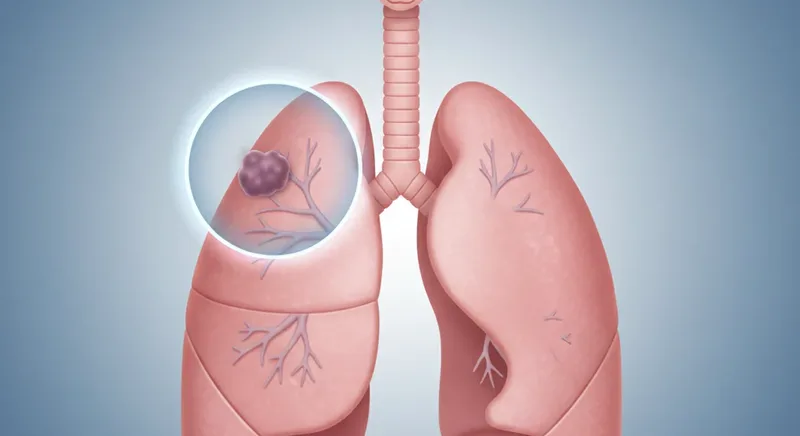
Le traitement du cancer du poumon dépend du stade et est choisi en fonction de l'âge, de l'état de santé et des comorbidités du patient. Les stades précoces (jusqu'au stade 3A inclus) sont traités par chirurgie, qui peut être suivie d'une chimiothérapie adjuvante et d'une radiothérapie.
1. Stades précoces (1-2) : la lutte pour l'ablation
Ici, l'objectif principal est l'ablation chirurgicale. Stade 1A : la chirurgie est le « traitement de référence » ; un traitement supplémentaire (chimiothérapie) n'est généralement pas nécessaire, car le risque l'emporte sur le bénéfice. Stade 1B : chirurgie, plus une chimiothérapie éventuelle uniquement en présence de facteurs de risque (tels que la taille de la tumeur). Stade 2 : chirurgie plus chimiothérapie adjuvante — ici, le traitement supplémentaire augmente la survie d'environ 5 %, il est donc recommandé plus souvent.
2. Maladie localement avancée (stade 3) : une attaque combinée
C'est le groupe le plus complexe, et le traitement ressemble souvent à une partie d'échecs. Parfois, la chimiothérapie et la radiothérapie sont administrées en premier pour réduire la taille de la tumeur, et la chirurgie n'est pratiquée qu'ensuite. Dans d'autres cas, la chirurgie n'est pas possible, on a donc recours à un traitement agressif combinant radiothérapie et médicaments.
3. Cancer du poumon avancé (stade 4)
Plus d'un tiers des personnes diagnostiquées ont déjà des métastases — c'est-à-dire une maladie de stade 4. En raison de la maladie avancée et des métastases dans les poumons, l'espérance de vie diminue. Statistiquement, de nombreux patients ne peuvent pas être guéris, il est donc très important d'aider le corps à se battre.
La nutrition comme bouclier anti-inflammatoire
Le cancer se développe dans un environnement inflammatoire ; votre objectif est de l'éteindre. Éliminer le sucre : les cellules cancéreuses consomment le glucose 10 à 50 fois plus vite que les cellules saines, donc réduire le sucre « affame » la tumeur. Graisses anti-inflammatoires : augmenter les oméga-3 (poissons gras, huile de chanvre), qui aident à prévenir la cachexie cancéreuse (perte de poids). Légumes crucifères : le brocoli et le chou contiennent du sulforaphane, qui aide le foie à détoxifier les résidus de chimiothérapie.
« Réglage » du système immunitaire
Au stade 4, l'organisme est épuisé. Des mesures supplémentaires peuvent l'aider à ne pas abandonner. Champignons médicinaux (lentinane) : ils ne traitent pas directement le cancer, mais activent vos cellules immunitaires (cellules NK) pour reconnaître et détruire plus efficacement les cellules cancéreuses. Il est important de choisir une formule concentrée de multi-extraits. Vitamine D3 : les taux sanguins sont souvent très bas chez les patients atteints de cancer ; maintenir un niveau élevé (environ 80-100 ng/ml) est essentiel pour l'immunité. La santé émotionnelle et l'activité physique comptent également.
Les champignons médicinaux sont étudiés pour leur capacité à activer les cellules NK afin qu'elles reconnaissent les cellules cancéreuses. Une formule concentrée de multi-extraits est préférable, ainsi qu'un taux élevé de vitamine D3.
Lentinan AXT par Zenius Labs™ →Foire aux questions
Aux stades 1 et 2, l'objectif principal est l'ablation chirurgicale. Stade 1A : la chirurgie est le traitement de référence, généralement sans chimiothérapie. Stade 1B : chirurgie plus chimiothérapie uniquement en présence de facteurs de risque. Stade 2 : chirurgie plus chimiothérapie adjuvante, qui augmente la survie d'environ 5 %.
Le stade 3 est le groupe le plus complexe. Parfois, la chimiothérapie et la radiothérapie sont administrées en premier pour réduire la taille de la tumeur avant la chirurgie ; dans d'autres cas, la chirurgie n'est pas possible et un traitement agressif combinant radiothérapie et médicaments est utilisé.
Plus d'un tiers des patients présentent des métastases au moment du diagnostic. Beaucoup ne peuvent pas être guéris, le traitement se concentre donc sur le contrôle de la maladie et l'aide à l'organisme — par le biais d'une nutrition anti-inflammatoire, d'un soutien immunitaire et de la vitamine D.
Les champignons médicinaux (lentinane) ne traitent pas directement le cancer, mais sont étudiés pour leur capacité à activer les cellules NK afin qu'elles reconnaissent et détruisent les cellules cancéreuses. Une formule concentrée de multi-extraits telle que Lentinan AXT de Zenius Labs™ est préférable, ainsi que le maintien de niveaux élevés de vitamine D3.
- Updated Analysis of KEYNOTE-024: Pembrolizumab Versus Platinum-Based Chemothe…. PubMed
- Five-Year Survival Outcomes With Atezolizumab After Chemotherapy in Resected …. PubMed
- Association between time-to-treatment and outcomes in non-small cell lung can…. PubMed
- Efficacy and safety of first-line carboplatin-versus cisplatin-based chemothe…. PubMed
- Yin X et al. A meta-analysis of lentinan injection combined with chemotherapy in the treatment of nonsmall cell lung cancer. Indian journal of cancer. 2015. PubMed
- Zhao C et al. Lentinan combined with cisplatin for the treatment of non-small cell lung cancer. Medicine. 2021. PubMed
- Li M et al. Lentinan triggers oxidative stress-mediated anti-inflammatory responses in lung cancer cells. Molecular and cellular biochemistry. 2022. PubMed
- Gui Y et al. Oridonin improves the therapeutic effect of lentinan on lung cancer. Experimental and therapeutic medicine. 2021. PubMed
- Wang Y et al. Investigation on the efficiency of lentinan for injection combining cisplatin on treating malignant pleural effusion based on systematic review and meta-analysis. Medicine. 2024. PubMed
- Song Z et al. Translational Nanotherapeutics Reprograms Immune Microenvironment in Malignant Pleural Effusion of Lung Adenocarcinoma. Advanced healthcare materials. 2021. PubMed
- Congcong Q et al. Evaluation of Efficacy and Safety for Lentinan in the Control of the Malignant Pleural Effusions via Intrapleural Injection. The American journal of the medical sciences. 2019. PubMed
- Ansell SM et al. PD-1 blockade with nivolumab in relapsed or refractory Hodgkin’s lymphoma. The New England journal of medicine. 2015. PubMed
- Goodman A et al. PD-1-PD-L1 immune-checkpoint blockade in B-cell lymphomas. Nature reviews. Clinical oncology. 2017. PubMed
- Zak J et al. JAK inhibition enhances checkpoint blockade immunotherapy in patients with Hodgkin lymphoma. Science (New York, N.Y.). 2024. PubMed
- Chen H et al. Integrative spatial analysis reveals tumor heterogeneity and immune colony niche related to clinical outcomes in small cell lung cancer. Cancer cell. 2025. PubMed
- Redin E et al. Dasatinib Remodels the Tumor Microenvironment and Sensitizes Small Cell Lung Cancer to Immunotherapy. Cancer research. 2025. PubMed
- Tani M et al. In vitro generation of activated natural killer cells and cytotoxic macrophages with lentinan. European journal of clinical pharmacology. 1992. PubMed
- Hamano K et al. The preoperative administration of lentinan ameliorated the impairment of natural killer activity after cardiopulmonary bypass. International journal of immunopharmacology. 1999. PubMed
- Mattiola I et al. The macrophage tetraspan MS4A4A enhances dectin-1-dependent NK cell-mediated resistance to metastasis. Nature immunology. 2019. PubMed
- Chandrakesan P et al. DCLK1-Isoform2 Alternative Splice Variant Promotes Pancreatic Tumor Immunosuppressive M2-Macrophage Polarization. Molecular cancer therapeutics. 2020. PubMed
- Fan TW et al. Polarization and β-Glucan Reprogram Immunomodulatory Metabolism in Human Macrophages and Ex Vivo in Human Lung Cancer Tissues. Journal of immunology (Baltimore, Md. : 1950). 2022. PubMed
- Fang J et al. Structure of a β-glucan from Grifola frondosa and its antitumor effect by activating Dectin-1/Syk/NF-κB signaling. Glycoconjugate journal. 2012. PubMed
- Zhang M et al. β-Glucan from Saccharomyces cerevisiae induces SBD-1 production in ovine ruminal epithelial cells via the Dectin-1-Syk-NF-κB signaling pathway. Cellular signalling. 2019. PubMed
- Gringhuis SI et al. Dectin-1 directs T helper cell differentiation by controlling noncanonical NF-kappaB activation through Raf-1 and Syk. Nature immunology. 2009. PubMed
- Ooshiro M et al. [Ten cases of advanced gastro-intestinal cancer that required preoperative dosage of PSK]. Gan to kagaku ryoho. Cancer & chemotherapy. 2009. PubMed
- Maehara Y et al. Postoperative PSK and OK-432 immunochemotherapy for patients with gastric cancer. Cancer chemotherapy and pharmacology. 1993. PubMed
- Ito G et al. Correlation between efficacy of PSK postoperative adjuvant immunochemotherapy for gastric cancer and expression of MHC class I. Experimental and therapeutic medicine. 2012. PubMed
- Cheng J et al. The Promising Effects of Astaxanthin on Lung Diseases. Advances in nutrition (Bethesda, Md.). 2021. PubMed
- Wu C et al. [Astaxanthin inhibits proliferation and promotes apoptosis of A549 lung cancer cells via blocking JAK1/STAT3 pathway]. Xi bao yu fen zi mian yi xue za zhi = Chinese journal of cellular and molecular immunology. 2016. PubMed
- Qian J et al. Molecular mechanisms underlying the beneficial effects of Astaxanthin on metabolic changes in lung cancer and diabetes mellitus: A dual pathophysiological perspective. International immunopharmacology. 2025. PubMed
- Park JS et al. Astaxanthin decreased oxidative stress and inflammation and enhanced immune response in humans. Nutrition & metabolism. 2010. PubMed
- Lee J et al. Anti-Oxidant and Anti-Inflammatory Effects of Astaxanthin on Gastrointestinal Diseases. International journal of molecular sciences. 2022. PubMed
- Wang T et al. Astaxanthin protected against the adverse effects induced by diesel exhaust particulate matter via improving membrane stability and anti-oxidative property. Journal of hazardous materials. 2023. PubMed
- Deng S et al. Lentinan inhibits tumor angiogenesis via interferon γ and in a T cell independent manner. Journal of experimental & clinical cancer research : CR. 2018. PubMed
- Deng S et al. Correction to: Lentinan inhibits tumor angiogenesis via interferon γ and in a T cell independent manner. Journal of experimental & clinical cancer research : CR. 2021. PubMed
- Wang H et al. Efficacy of biological response modifier lentinan with chemotherapy for advanced cancer: a meta-analysis. Cancer medicine. 2017. PubMed
- Zhang Y et al. Lentinan as an immunotherapeutic for treating lung cancer: a review of 12 years clinical studies in China. Journal of cancer research and clinical oncology. 2018. PubMed
- Wang XE et al. Immunomodulatory Effect of Lentinan on Aberrant T Subsets and Cytokines Profile in Non-small Cell Lung Cancer Patients. Pathology oncology research : POR. 2020. PubMed
- Wang Y et al. Systematic review and meta-analysis on the efficacy and safety of Injectable Lentinan combined with chemotherapy in the treatment of gastric cancer. Phytomedicine : international journal of phytotherapy and phytopharmacology. 2024. PubMed
- Oba K et al. Efficacy of adjuvant immunochemotherapy with polysaccharide K for patients with curative resections of gastric cancer. Cancer immunology, immunotherapy : CII. 2007. PubMed
- Cheng SC et al. mTOR- and HIF-1α-mediated aerobic glycolysis as metabolic basis for trained immunity. Science (New York, N.Y.). 2014. PubMed
- Kidd P Astaxanthin, cell membrane nutrient with diverse clinical benefits and anti-aging potential. Alternative medicine review : a journal of clinical therapeutic. 2011. PubMed