Was ist ein diffus-großzelliges B-Zell-Lymphom?
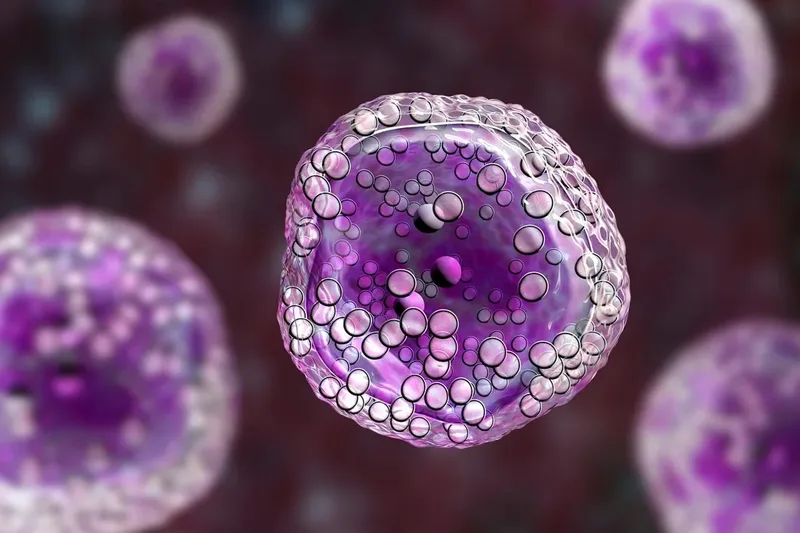
Das diffus-großzellige B-Zell-Lymphom ist ein aggressives Non-Hodgkin-Lymphom, das sich aus den B-Zellen des Lymphsystems entwickelt. Unter dem Mikroskop sind große bösartige Lymphozyten sichtbar. Das diffus-großzellige B-Zell-Lymphom ist die häufigste Art des Non-Hodgkin-Lymphoms.
Symptome des diffus-großzelligen B-Zell-Lymphoms
Oft ist das erste Symptom eine schmerzlose Schwellung am Hals, in der Achselhöhle oder in der Leistengegend, die durch vergrößerte Lymphknoten verursacht wird. Diese Knoten können recht schnell wachsen, oft innerhalb weniger Wochen. Manchmal sind auch andere Körperteile betroffen. Die Krankheit kann außerhalb der Lymphknoten auftreten und den Magen oder den Darm befallen, was zu Bauchbeschwerden oder -schmerzen, Durchfall oder Blutungen führt. Dieses Lymphom kann auch in vielen anderen Bereichen auftreten, einschließlich der Speicheldrüsen, Nasennebenhöhlen, Leber, Lunge, Hoden, Haut, Gehirn oder Augen, wobei die Symptome direkt vom Ort des Befalls abhängen.
Ursachen des diffus-großzelligen B-Zell-Lymphoms
Obwohl die genauen Ursachen nicht bekannt sind, handelt es sich nicht um eine Erbkrankheit. Menschen, deren Immunsystem geschwächt ist, haben möglicherweise ein höheres Risiko, daran zu erkranken – dazu können Menschen gehören, die zuvor wegen anderer Krebsarten behandelt wurden, oder Menschen mit Autoimmunerkrankungen.
Behandlung des diffus-großzelligen B-Zell-Lymphoms
Das diffus-großzellige B-Zell-Lymphom ist eine sich schnell entwickelnde Krankheit, die dringend behandelt werden muss. Die derzeitige Behandlung besteht aus einer zielgerichteten Therapie und einer Standard-Chemotherapie, die in der Regel etwa 4 Monate lang fortgesetzt wird. Bei der Chemotherapie werden Medikamente eingesetzt, um den Krebs zu zerstören, was mehrere Nebenwirkungen haben kann. Andere Behandlungsmethoden sind Bestrahlung und Stammzelltransplantation.
Nahrungsergänzungsmittel bei Krebs
Es ist unerlässlich, Ihre Ernährung und die anderen Faktoren (lange Spaziergänge, Atmung, Verzicht auf krebserregende Stoffe usw.), die nur Sie selbst in der Hand haben, zu regeln. Dann wird eine Krebsbehandlung (wie z. B. eine Chemotherapie) noch wirksamer sein. Mit natürlichen Nahrungsergänzungsmitteln (wie Lentinan) können Sie das Immunsystem bei der Bekämpfung von Krebszellen unterstützen. Aus Heilpilzen gewonnene Wirkstoffe verbessern die Lebensqualität, unterstützen den Kampf gegen Krebs und können sogar die Wirksamkeit von Medikamenten erhöhen. Diese im Osten (in Japan) weit verbreiteten Verbindungen sind starke Immunmodulatoren, die das Immunsystem veranlassen, Krebszellen zu erkennen und auf sie zu reagieren.
Konzentrierte Pilz-Polysaccharide werden auf ihre Fähigkeit hin untersucht, NK-Zellen und Makrophagen zu aktivieren und die Lebensqualität begleitend zur Chemotherapie zu unterstützen.
Lentinan AXT von Zenius Labs™ →Häufig gestellte Fragen
Es handelt sich um ein aggressives Non-Hodgkin-Lymphom, das sich aus den B-Zellen des Lymphsystems entwickelt, wobei unter dem Mikroskop große bösartige Lymphozyten sichtbar sind. Es ist die häufigste Art des Non-Hodgkin-Lymphoms.
Es handelt sich um eine sich schnell entwickelnde Krankheit – Knoten können innerhalb weniger Wochen wachsen – daher muss sie dringend behandelt werden.
Nein. Die genauen Ursachen sind nicht bekannt, aber es ist nicht erblich. Menschen mit geschwächtem Immunsystem – einschließlich derer, die zuvor wegen anderer Krebsarten behandelt wurden oder an Autoimmunerkrankungen leiden – haben möglicherweise ein höheres Risiko, daran zu erkranken.
Die derzeitige Behandlung besteht aus einer zielgerichteten Therapie und einer Standard-Chemotherapie, die in der Regel etwa 4 Monate lang fortgesetzt wird. Weitere Optionen sind Bestrahlung und Stammzelltransplantation.
Ja. Konzentrierte Pilz-Polysaccharid-Extrakte werden auf ihre Rolle bei der Aktivierung von NK-Zellen und Makrophagen und der Unterstützung der Lebensqualität begleitend zur Chemotherapie untersucht. Eine konzentrierte Multi-Extrakt-Formel wie Lentinan AXT von Zenius Labs™ ist einfachen Pulvern vorzuziehen.
- CAR T-cell therapy in large B cell lymphoma. PubMed
- CAR T cells vs bispecific antibody as third- or later-line large B-cell lymph…. PubMed
- Recent advances in CAR T-cell toxicity: Mechanisms, manifestations and manage…. PubMed
- Tani M et al. In vitro generation of activated natural killer cells and cytotoxic macrophages with lentinan. European journal of clinical pharmacology. 1992. PubMed
- Hamano K et al. The preoperative administration of lentinan ameliorated the impairment of natural killer activity after cardiopulmonary bypass. International journal of immunopharmacology. 1999. PubMed
- Mattiola I et al. The macrophage tetraspan MS4A4A enhances dectin-1-dependent NK cell-mediated resistance to metastasis. Nature immunology. 2019. PubMed
- Zhou X et al. The role of complement in the mechanism of action of rituximab for B-cell lymphoma: implications for therapy. The oncologist. 2008. PubMed
- Li B et al. Yeast beta-glucan amplifies phagocyte killing of iC3b-opsonized tumor cells via complement receptor 3-Syk-phosphatidylinositol 3-kinase pathway. Journal of immunology (Baltimore, Md. : 1950). 2006. PubMed
- Xia Y et al. The beta-glucan-binding lectin site of mouse CR3 (CD11b/CD18) and its function in generating a primed state of the receptor that mediates cytotoxic activation in response to iC3b-opsonized target cells. Journal of immunology (Baltimore, Md. : 1950). 1999. PubMed
- Lu H et al. TLR2 agonist PSK activates human NK cells and enhances the antitumor effect of HER2-targeted monoclonal antibody therapy. Clinical cancer research : an official journal of the American Association for Cancer Research. 2011. PubMed
- Ooshiro M et al. [Ten cases of advanced gastro-intestinal cancer that required preoperative dosage of PSK]. Gan to kagaku ryoho. Cancer & chemotherapy. 2009. PubMed
- Maehara Y et al. Postoperative PSK and OK-432 immunochemotherapy for patients with gastric cancer. Cancer chemotherapy and pharmacology. 1993. PubMed
- Adachi Y et al. Potentiation of Antitumor Activity by Antibody Drugs and Mushroom-Derived β-Glucans in Natural Killer Cell-Mediated Tumoricidal Activities against Non-Hodgkin’s B-Cell Lymphoma. International journal of medicinal mushrooms. 2023. PubMed
- Sam J et al. Preclinical advances in glofitamab combinations: a new frontier for non-Hodgkin lymphoma. Blood. 2025. PubMed
- Ansell SM et al. PD-1 blockade with nivolumab in relapsed or refractory Hodgkin’s lymphoma. The New England journal of medicine. 2015. PubMed
- Azoulay T et al. Compromised activity of natural killer cells in diffuse large b-cell lymphoma is related to lymphoma-induced modification of their surface receptor expression. Cancer immunology, immunotherapy : CII. 2023. PubMed
- Sato A et al. [Pathogenesis and novel therapy for EBV-related B-cell lymphoma]. [Rinsho ketsueki] The Japanese journal of clinical hematology. 2016. PubMed
- Chen J et al. Epstein-Barr virus: biology, pathogenesis and therapy of lymphomas. Discover oncology. 2025. PubMed
- Liquidano-Perez E et al. Case Report: Hydroa vacciniforme-like lymphoproliferative disorder, an EBV-associated disease, successfully treated with hematopoietic stem cell transplantation. Frontiers in immunology. 2025. PubMed
- Song JY et al. Low T-cell proportion in the tumor microenvironment is associated with immune escape and poor survival in diffuse large B-cell lymphoma. Haematologica. 2023. PubMed
- Greenbaum AM et al. Diffuse large B-cell lymphoma (DLBCL) is infiltrated with activated CD8(+) T-cells despite immune checkpoint signaling. Blood research. 2022. PubMed
- Liu WR et al. Signaling pathways and immune evasion mechanisms in classical Hodgkin lymphoma. Blood. 2017. PubMed
- Wang D et al. Dectin-1 stimulates IL-33 expression in dendritic cells via upregulation of IRF4. Laboratory investigation; a journal of technical methods and pathology. 2018. PubMed
- Engel AL et al. Protein-bound polysaccharide activates dendritic cells and enhances OVA-specific T cell response as vaccine adjuvant. Immunobiology. 2013. PubMed
- Wang Y et al. Systematic review and meta-analysis on the efficacy and safety of Injectable Lentinan combined with chemotherapy in the treatment of gastric cancer. Phytomedicine : international journal of phytotherapy and phytopharmacology. 2024. PubMed
- Oba K et al. Individual patient based meta-analysis of lentinan for unresectable/recurrent gastric cancer. Anticancer research. 2009. PubMed
- Wang Y et al. Investigation on the efficiency of lentinan for injection combining cisplatin on treating malignant pleural effusion based on systematic review and meta-analysis. Medicine. 2024. PubMed
- Park JS et al. Astaxanthin decreased oxidative stress and inflammation and enhanced immune response in humans. Nutrition & metabolism. 2010. PubMed
- Cheng J et al. The Promising Effects of Astaxanthin on Lung Diseases. Advances in nutrition (Bethesda, Md.). 2021. PubMed
- Lee J et al. Anti-Oxidant and Anti-Inflammatory Effects of Astaxanthin on Gastrointestinal Diseases. International journal of molecular sciences. 2022. PubMed
- Cheng SC et al. mTOR- and HIF-1α-mediated aerobic glycolysis as metabolic basis for trained immunity. Science (New York, N.Y.). 2014. PubMed
- van der Meer JW et al. Trained immunity: A smart way to enhance innate immune defence. Molecular immunology. 2015. PubMed
- Vuscan P et al. Potent induction of trained immunity by Saccharomyces cerevisiae β-glucans. Frontiers in immunology. 2024. PubMed
- Zou X et al. Radioprotective effect of edible and medicinal mushrooms against ionizing radiation: Components, potential mechanisms, and applications. Food research international (Ottawa, Ont.). 2025. PubMed
- Liu F et al. The mechanisms for the radioprotective effect of beta-d-glucan on high linear-energy-transfer carbon ion irradiated mice. International journal of biological macromolecules. 2019. PubMed
- Christophersen OA Radiation protection following nuclear power accidents: a survey of putative mechanisms involved in the radioprotective actions of taurine during and after radiation exposure. Microbial ecology in health and disease. 2012. PubMed
- Fang J et al. Structure of a β-glucan from Grifola frondosa and its antitumor effect by activating Dectin-1/Syk/NF-κB signaling. Glycoconjugate journal. 2012. PubMed
- Zhang M et al. β-Glucan from Saccharomyces cerevisiae induces SBD-1 production in ovine ruminal epithelial cells via the Dectin-1-Syk-NF-κB signaling pathway. Cellular signalling. 2019. PubMed
- Gringhuis SI et al. Dectin-1 directs T helper cell differentiation by controlling noncanonical NF-kappaB activation through Raf-1 and Syk. Nature immunology. 2009. PubMed