What is diffuse large B-cell lymphoma?
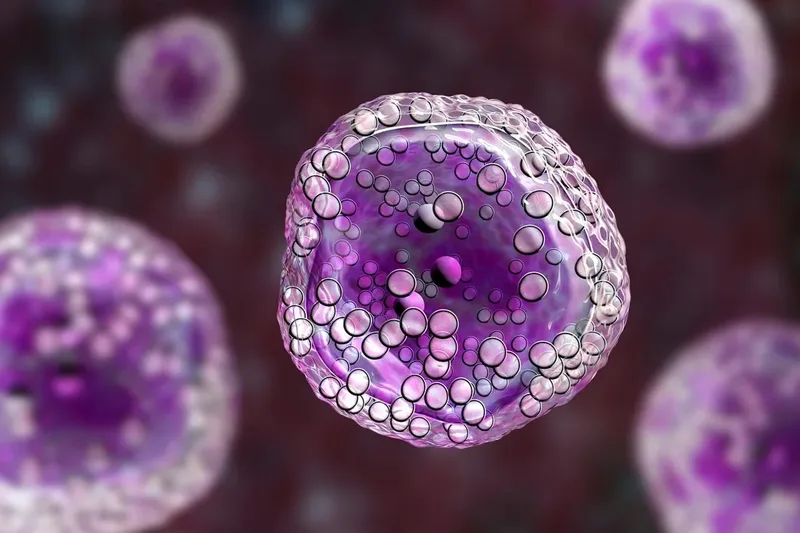
Diffuse large B-cell lymphoma is an aggressive non-Hodgkin lymphoma that develops from the B cells of the lymphatic system. Under the microscope, large malignant lymphocytes are visible. Diffuse large B-cell lymphoma is the most common type of non-Hodgkin lymphoma.
Symptoms of diffuse large B-cell lymphoma
Often the first symptom is painless swelling in the neck, armpit or groin, caused by enlarged lymph nodes. These lumps can grow quite quickly, often within a few weeks. Sometimes other parts of the body are affected. The disease can occur outside the lymph nodes and may involve the stomach or intestines, causing abdominal discomfort or pain, diarrhea or bleeding. This lymphoma can also appear in many other areas, including the salivary glands, sinuses, liver, lungs, testicles, skin, brain or eyes, with symptoms depending directly on the location.
Causes of diffuse large B-cell lymphoma
Although the exact causes are not known, it is not a hereditary disease. People whose immune systems are impaired may be more likely to develop it — this can include people previously treated for other forms of cancer, or people with autoimmune disorders.
Treatment of diffuse large B-cell lymphoma
Diffuse large B-cell lymphoma is a rapidly developing disease, so it needs to be treated urgently. Current treatment is targeted therapy and standard chemotherapy, usually continued for about 4 months. Chemotherapy uses drugs to destroy the cancer and can have several side effects. Other treatment methods include radiation and stem-cell transplantation.
Supplements for cancer
It is essential to sort out your diet and the other factors (long walks, breathing, giving up cancer-causing substances and so on) that only you can manage. Then cancer treatment (such as chemotherapy) will be even more effective. With natural supplements (such as Lentinan) you can help the immune system fight cancer cells. Active compounds extracted from medicinal mushrooms improve quality of life, support the fight against cancer, and may even increase the effectiveness of medications. These compounds, widely used in the East (in Japan), are powerful immunomodulators that prompt the immune system to detect and act on cancer cells.
Concentrated mushroom polysaccharides are studied for activating NK cells and macrophages and supporting quality of life alongside chemotherapy.
Lentinan AXT by Zenius Labs™ →Frequently Asked Questions
It is an aggressive non-Hodgkin lymphoma developing from the B cells of the lymphatic system, with large malignant lymphocytes visible under the microscope. It is the most common type of non-Hodgkin lymphoma.
It is a rapidly developing disease — lumps can grow within a few weeks — so it needs to be treated urgently.
No. The exact causes are not known, but it is not hereditary. People with impaired immune systems — including those previously treated for other cancers or with autoimmune disorders — may be more likely to develop it.
Current treatment is targeted therapy and standard chemotherapy, usually continued for about 4 months. Other options include radiation and stem-cell transplantation.
Yes. Concentrated mushroom-polysaccharide extracts are studied for their role in activating NK cells and macrophages and supporting quality of life alongside chemotherapy. A concentrated multi-extract formula such as Lentinan AXT by Zenius Labs™ is preferable to simple powders.
- CAR T-cell therapy in large B cell lymphoma. PubMed
- CAR T cells vs bispecific antibody as third- or later-line large B-cell lymph…. PubMed
- Recent advances in CAR T-cell toxicity: Mechanisms, manifestations and manage…. PubMed
- Tani M et al. In vitro generation of activated natural killer cells and cytotoxic macrophages with lentinan. European journal of clinical pharmacology. 1992. PubMed
- Hamano K et al. The preoperative administration of lentinan ameliorated the impairment of natural killer activity after cardiopulmonary bypass. International journal of immunopharmacology. 1999. PubMed
- Mattiola I et al. The macrophage tetraspan MS4A4A enhances dectin-1-dependent NK cell-mediated resistance to metastasis. Nature immunology. 2019. PubMed
- Zhou X et al. The role of complement in the mechanism of action of rituximab for B-cell lymphoma: implications for therapy. The oncologist. 2008. PubMed
- Li B et al. Yeast beta-glucan amplifies phagocyte killing of iC3b-opsonized tumor cells via complement receptor 3-Syk-phosphatidylinositol 3-kinase pathway. Journal of immunology (Baltimore, Md. : 1950). 2006. PubMed
- Xia Y et al. The beta-glucan-binding lectin site of mouse CR3 (CD11b/CD18) and its function in generating a primed state of the receptor that mediates cytotoxic activation in response to iC3b-opsonized target cells. Journal of immunology (Baltimore, Md. : 1950). 1999. PubMed
- Lu H et al. TLR2 agonist PSK activates human NK cells and enhances the antitumor effect of HER2-targeted monoclonal antibody therapy. Clinical cancer research : an official journal of the American Association for Cancer Research. 2011. PubMed
- Ooshiro M et al. [Ten cases of advanced gastro-intestinal cancer that required preoperative dosage of PSK]. Gan to kagaku ryoho. Cancer & chemotherapy. 2009. PubMed
- Maehara Y et al. Postoperative PSK and OK-432 immunochemotherapy for patients with gastric cancer. Cancer chemotherapy and pharmacology. 1993. PubMed
- Adachi Y et al. Potentiation of Antitumor Activity by Antibody Drugs and Mushroom-Derived β-Glucans in Natural Killer Cell-Mediated Tumoricidal Activities against Non-Hodgkin’s B-Cell Lymphoma. International journal of medicinal mushrooms. 2023. PubMed
- Sam J et al. Preclinical advances in glofitamab combinations: a new frontier for non-Hodgkin lymphoma. Blood. 2025. PubMed
- Ansell SM et al. PD-1 blockade with nivolumab in relapsed or refractory Hodgkin’s lymphoma. The New England journal of medicine. 2015. PubMed
- Azoulay T et al. Compromised activity of natural killer cells in diffuse large b-cell lymphoma is related to lymphoma-induced modification of their surface receptor expression. Cancer immunology, immunotherapy : CII. 2023. PubMed
- Sato A et al. [Pathogenesis and novel therapy for EBV-related B-cell lymphoma]. [Rinsho ketsueki] The Japanese journal of clinical hematology. 2016. PubMed
- Chen J et al. Epstein-Barr virus: biology, pathogenesis and therapy of lymphomas. Discover oncology. 2025. PubMed
- Liquidano-Perez E et al. Case Report: Hydroa vacciniforme-like lymphoproliferative disorder, an EBV-associated disease, successfully treated with hematopoietic stem cell transplantation. Frontiers in immunology. 2025. PubMed
- Song JY et al. Low T-cell proportion in the tumor microenvironment is associated with immune escape and poor survival in diffuse large B-cell lymphoma. Haematologica. 2023. PubMed
- Greenbaum AM et al. Diffuse large B-cell lymphoma (DLBCL) is infiltrated with activated CD8(+) T-cells despite immune checkpoint signaling. Blood research. 2022. PubMed
- Liu WR et al. Signaling pathways and immune evasion mechanisms in classical Hodgkin lymphoma. Blood. 2017. PubMed
- Wang D et al. Dectin-1 stimulates IL-33 expression in dendritic cells via upregulation of IRF4. Laboratory investigation; a journal of technical methods and pathology. 2018. PubMed
- Engel AL et al. Protein-bound polysaccharide activates dendritic cells and enhances OVA-specific T cell response as vaccine adjuvant. Immunobiology. 2013. PubMed
- Wang Y et al. Systematic review and meta-analysis on the efficacy and safety of Injectable Lentinan combined with chemotherapy in the treatment of gastric cancer. Phytomedicine : international journal of phytotherapy and phytopharmacology. 2024. PubMed
- Oba K et al. Individual patient based meta-analysis of lentinan for unresectable/recurrent gastric cancer. Anticancer research. 2009. PubMed
- Wang Y et al. Investigation on the efficiency of lentinan for injection combining cisplatin on treating malignant pleural effusion based on systematic review and meta-analysis. Medicine. 2024. PubMed
- Park JS et al. Astaxanthin decreased oxidative stress and inflammation and enhanced immune response in humans. Nutrition & metabolism. 2010. PubMed
- Cheng J et al. The Promising Effects of Astaxanthin on Lung Diseases. Advances in nutrition (Bethesda, Md.). 2021. PubMed
- Lee J et al. Anti-Oxidant and Anti-Inflammatory Effects of Astaxanthin on Gastrointestinal Diseases. International journal of molecular sciences. 2022. PubMed
- Cheng SC et al. mTOR- and HIF-1α-mediated aerobic glycolysis as metabolic basis for trained immunity. Science (New York, N.Y.). 2014. PubMed
- van der Meer JW et al. Trained immunity: A smart way to enhance innate immune defence. Molecular immunology. 2015. PubMed
- Vuscan P et al. Potent induction of trained immunity by Saccharomyces cerevisiae β-glucans. Frontiers in immunology. 2024. PubMed
- Zou X et al. Radioprotective effect of edible and medicinal mushrooms against ionizing radiation: Components, potential mechanisms, and applications. Food research international (Ottawa, Ont.). 2025. PubMed
- Liu F et al. The mechanisms for the radioprotective effect of beta-d-glucan on high linear-energy-transfer carbon ion irradiated mice. International journal of biological macromolecules. 2019. PubMed
- Christophersen OA Radiation protection following nuclear power accidents: a survey of putative mechanisms involved in the radioprotective actions of taurine during and after radiation exposure. Microbial ecology in health and disease. 2012. PubMed
- Fang J et al. Structure of a β-glucan from Grifola frondosa and its antitumor effect by activating Dectin-1/Syk/NF-κB signaling. Glycoconjugate journal. 2012. PubMed
- Zhang M et al. β-Glucan from Saccharomyces cerevisiae induces SBD-1 production in ovine ruminal epithelial cells via the Dectin-1-Syk-NF-κB signaling pathway. Cellular signalling. 2019. PubMed
- Gringhuis SI et al. Dectin-1 directs T helper cell differentiation by controlling noncanonical NF-kappaB activation through Raf-1 and Syk. Nature immunology. 2009. PubMed